Z'BRDA Z'DOLA since 1998
HR

Z'BRDA

Health

Food, movement, sleep, the body. This isn't a section of advice but of checking - what is actually known, how firmly, and where marketing starts calling itself science. If a figure has no source, it isn't here.

Edited by Nino Ciglenečki and Iris.

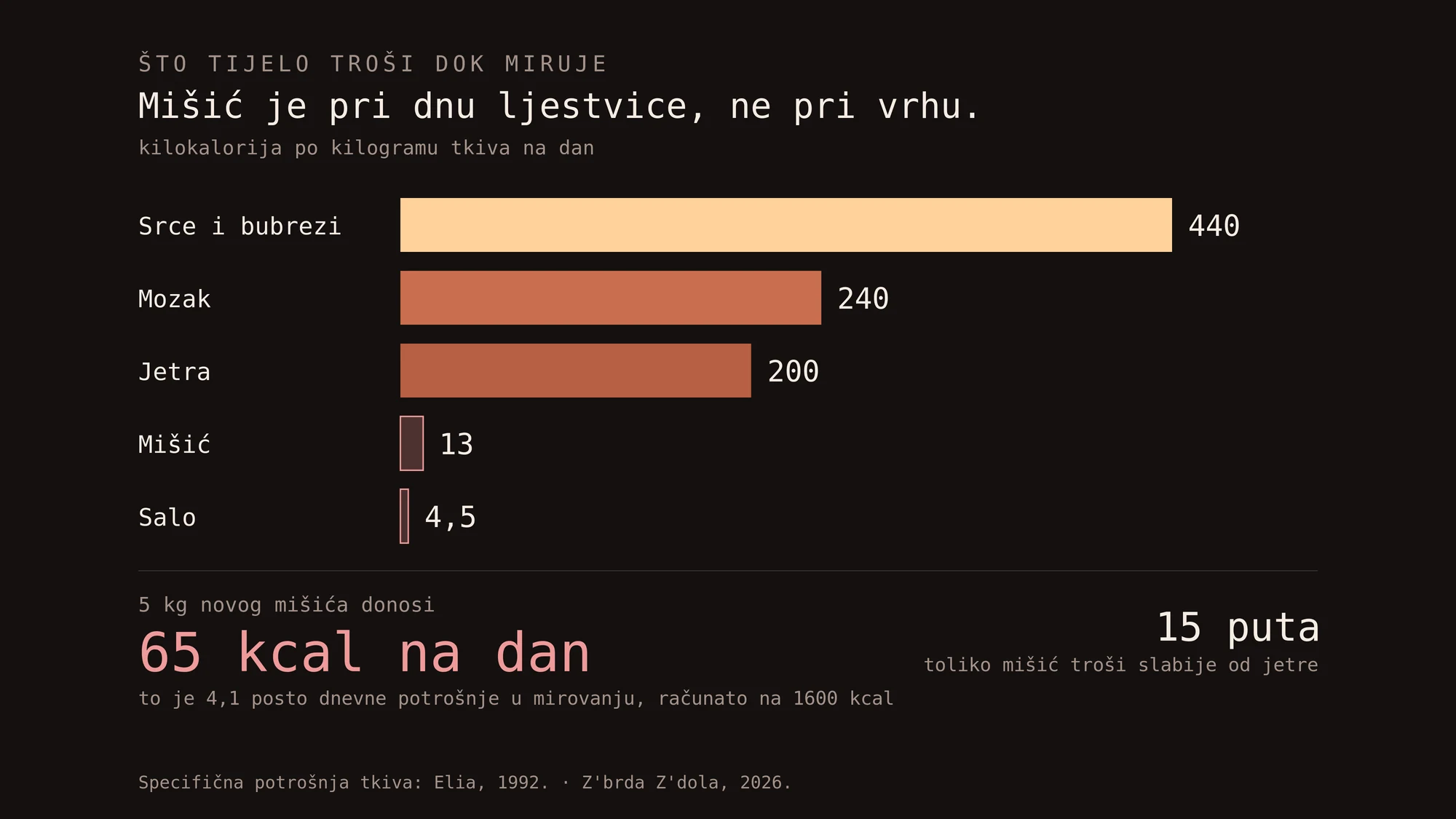
What each tissue burns at rest, per kilogram per day. Our graphic.

22 September 2026 · Nino Ciglenečki & Iris · Hrvatski

Why fat moves to the middle after fifty, and what actually shifts it

After fifty the body does not so much gain more fat as store it somewhere else, and the scale does not notice. We went through the large trials and kept only what somebody actually measured: what removes visceral fat, what only looks as if it does, and how much muscle really burns at rest.
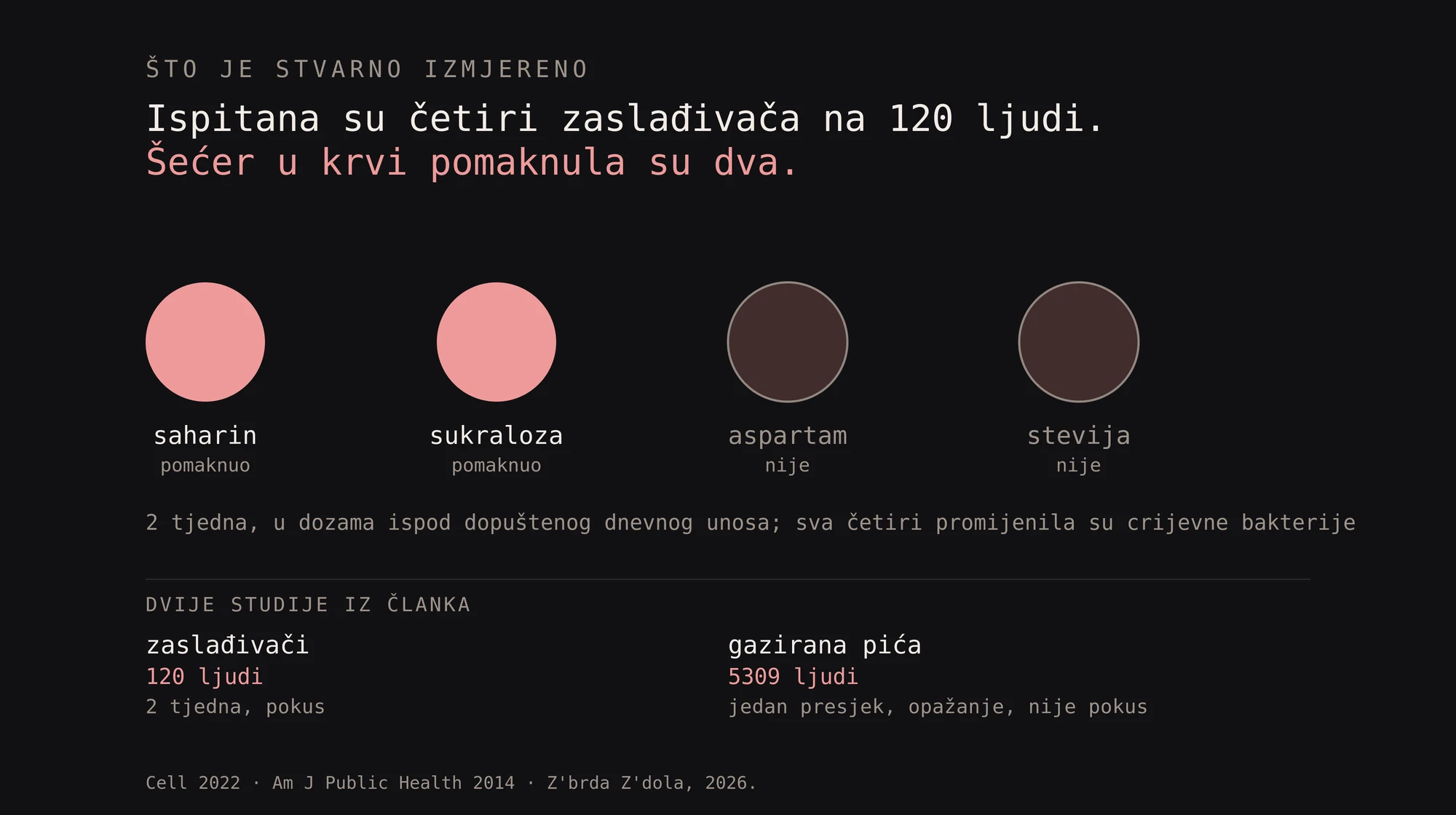
The four sweeteners in the trial, two of which moved blood sugar. Our graphic.

21 September 2026 · Nino Ciglenečki & Iris · Hrvatski

Sugar-free does not mean effect-free: what was measured in 120 people

Four artificial sweeteners, two weeks, doses below the permitted limits. Two of the four moved blood sugar, and did it differently from one person to the next. Along the way we ran into a famous study that gets quoted against fruit juice for years, while saying the opposite.
channels we recommend

Athlean-XDr. Sten EkbergThomas DeLauerGlucose RevolutionFelix HarderDan GoDr. Eric BergDr. BozKen D. BerryMark HymanBryan Johnson

We follow these to know what is being talked about, nothing more. None of them is a source - most of them sell supplements, programmes or books. The source is always the study a news item links to.

fact checked

  • PUCKETANJE PRSTIMA

    CRACKING KNUCKLES - parents warn that cracking your knuckles leads to arthritis. A 2011 study by Kevin deWeber and colleagues, published in the Journal of the American Board of Family Medicine, covered 215 people aged 50 to 89 with hand X-rays: osteoarthritis was about as common among those who crack their knuckles (18.1 percent) as among those who do not (21.5 percent). The study is retrospective and cannot prove cause, but it found no link with hand osteoarthritis.

    1 Oct 2026

    deWeber et al., JABFM 2011 ↗

  • KREATIN I OPADANJE KOSE

    CREATINE AND HAIR LOSS - in gyms you often hear that creatine raises the hormone DHT and makes your hair fall out. The fear goes back to a single 2009 paper: in 20 young rugby players DHT rose by 56 percent after a week of high doses and stayed 40 percent higher after two more weeks of lower doses. That paper measured only hormones, not hair. A 2025 trial tested it directly: 38 men who lift weights took five grams of creatine a day or a placebo for 12 weeks, and the groups did not differ in DHT, hair density, follicle count or hair thickness.

    25 Sep 2026

    van der Merwe et al., Clinical Journal of Sport Medicine, 2009, rugby players and DHT ↗Lak et al., JISSN, 2025, creatine and hair over 12 weeks ↗

  • POST I MIŠIĆI

    FASTING AND MUSCLE - fitness circles hold that any longer fast immediately starts eating into muscle. In a controlled trial published in Clinical Nutrition, 27 men with overweight or obesity spent ten days alternating days on a quarter of their usual food with days on full intake. They ate the same amount of protein as the control group, and their rate of muscle protein synthesis did not differ. In a complete 72-hour fast, in a small trial of eight healthy men, the muscles did start releasing more amino acids. Neither study measured a fast of exactly 24 hours.

    24 Sep 2026

    Clinical Nutrition, intermittent fasting and muscle protein synthesis ↗PLOS One, muscle after a 72-hour fast ↗

  • CINK ZA PREHLADU

    ZINC FOR A COLD - it is claimed that zinc taken at the first sign of a cold shortens the illness considerably. A 2024 Cochrane review covered 34 studies and 8,526 people. Taken as a treatment, zinc shortened colds by about 2.4 days, but the individual studies disagreed so widely that the authors rated their confidence in the finding as low. For preventing colds, zinc showed no effect. Mild side effects, mostly nausea and a strange taste in the mouth, were noticeably more common than with placebo.

    21 Sep 2026

    Cochrane, a review of 34 studies on zinc and the common cold ↗

What is measured, and how firmly. Not advice.

one interesting thing

  • POSTUPNO SMANJENJEKOFEINA

    CUTTING DOWN ON CAFFEINE - a randomised clinical trial on 109 adults, published in Drug and Alcohol Dependence, confirmed that guided, gradual reduction significantly alleviates adverse symptoms such as anxiety and sleep disturbances. Participants who used a six-week reduction manual decreased their average daily caffeine intake from 565 to 233 milligrams. Measurements recorded statistically significant drops in side effects and improvements in sleep quality without requiring direct clinical supervision.

    14 Sep 2026

    PubMed, the trial's abstract ↗

  • JAKOST I DUGOVJEČNOST

    STRENGTH AND LONGEVITY - thirty years of following 147,374 people across three US cohorts found that 90 to 119 minutes of strength training a week is associated with a 13 per cent lower risk of death from any cause, 19 per cent lower from cardiovascular disease and 27 per cent lower from neurological disease. Above 120 minutes a week there is no further benefit. The average age at entry was 54, and 35,798 participants died during the follow-up. The paper was published on 2 June 2026 in the British Journal of Sports Medicine and is observational, so it does not prove causation.

    2 Sep 2026

    BMJ, on the study ↗

  • SLEEP

    SLEEP - in a trial with 88 healthy young adults, memory was measured after a night of 4.5 hours' sleep and after a night of 8.5 hours, with or without half an hour of moderate stationary cycling at 7 p.m. The group that exercised before the short night did better on delayed recall of face-name pairs than the group that did not, and the difference was statistically mediated by the share of slow-wave sleep recorded by polysomnography.

    1 Sep 2026

    the journal Sleep ↗

section archive - older news and older articles →