Z'BRDA Z'DOLA since 1998
HR

Z'BRDA

Science

Science news usually arrives with an exclamation mark. What interests us is the duller part: who measured it, on what, who confirmed it, and how far it is from actual use. A laboratory record and a product you can buy are two different things.

Edited by Nino Ciglenečki and Iris.

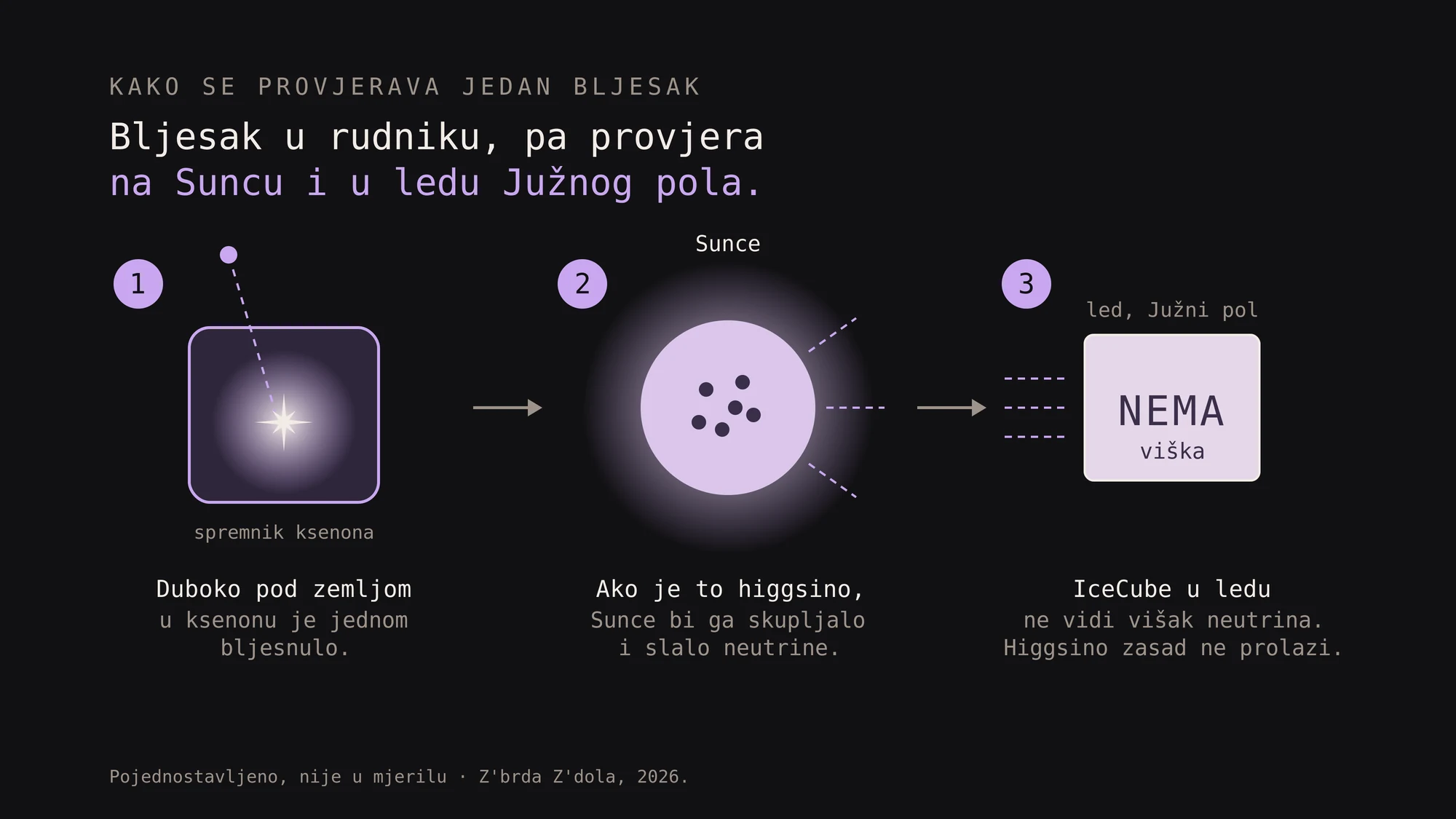
Three steps: a flash in the mine, then a check on the Sun and in the South Pole ice. Our graphic.

22 September 2026 · Nino Ciglenečki & Iris · Hrvatski

One flash in a mine: have we finally caught dark matter?

A detector deep underground recorded a single flash that might be dark matter, and physicists rushed to explain it. The most interesting explanation got its first test within a week, and part of the answer came from the ice at the South Pole.
From a video by the Zavan channel - the video is at the foot of this piece

18 August 2026 · Nino Ciglenečki & Iris · Hrvatski

The brain has a "delete key"

You don't forget your dreams because your memory leaks. You forget them because there's a crew of cells in your head whose only job that is - and it clocks in only while you're asleep.

channels we recommend

Jim Al-KhaliliCleo AbramStarTalkArvin AshImagine the PhysicsEpic SpacemanBrian CoxHannah FryAnton PetrovSabine HossenfelderKurzgesagtHistory of the Universe

fact checked

  • KINESKI ZID IZ SVEMIRA

    THE GREAT WALL FROM SPACE - it is said that the Great Wall of China is the only man-made structure visible from space. NASA writes that from low Earth orbit it is very hard to make out with the naked eye, because its colour and texture are almost the same as the ground around it: Chinese astronaut Yang Liwei did not see it, and the first confirmed photographs were taken by Leroy Chiao in 2004 with a 180 millimetre lens. From the Moon no man-made structure is visible at all, while cities at night, highways, airports and dams are easy to see from orbit.

    1 Oct 2026

    NASA, the Great Wall from orbit ↗

  • SMRZAVANJE U SVEMIRU

    FREEZING IN SPACE - in films, a person thrown into space without a suit freezes solid within seconds. In reality a vacuum is a good insulator, since there is no air to carry heat away, so the body cools slowly, with the mouth and nose cooling fastest because water keeps evaporating from them. What actually kills is the lack of oxygen. In 1965 a technician at NASA's Johnson centre lost consciousness within 12 to 15 seconds after his suit depressurised, and recovered unharmed.

    25 Sep 2026

    Scientific American, surviving in a vacuum ↗Geoffrey Landis, NASA, does a person freeze in a vacuum ↗

  • BRZINA SVJETLOSTI

    SPEED OF LIGHT - in science fiction a ship with a powerful enough engine eventually reaches the speed of light. In reality every extra bit of energy buys an ever smaller gain in speed. CERN's LHC accelerates protons to 6.8 TeV, about 7,250 times their rest energy, and they travel at 99.999999 percent of the speed of light. If their energy were doubled, their speed would rise by less than a millionth of a percent. Reaching the speed of light itself would take infinite energy, so no object with mass can ever get there.

    24 Sep 2026

    CERN, the LHC and its 6.8 TeV protons ↗

  • ŽVAKAĆA GUMA

    CHEWING GUM IN THE STOMACH - the story says swallowed gum stays in the body for seven years because it cannot be digested. That figure appears in no medical paper. Gum genuinely is not broken down, but it leaves the body like anything else that is not digested. The only recorded problem was described in Pediatrics in 1998, where three children developed an obstruction after swallowing gum regularly and in quantity. Three cases in the world literature are not a reason for fear, but they are a reason not to give gum to small children.

    21 Sep 2026

    Pediatrics, three children with chewing gum obstruction ↗

What is measured, and how firmly. Not advice.

one interesting thing

  • NASA

    NASA - at the end of September 2026 the agency selected three new science payloads for its Moon base programme, to be carried to the surface by commercial landers of the CLPS programme. One will monitor micrometeoroids, volatiles and moonquakes near the south pole, another will look for underground tunnels carved by flowing lava in the Marius Hills pit, and the third will measure ice hidden in small cold traps. The release gives neither contract values nor delivery dates.

    1 Oct 2026

    NASA, three new investigations for the Moon base ↗

  • NISAR

    NISAR - on 24 September 2026 NASA released a time-lapse of the eruption of Krasheninnikov volcano on Kamchatka, assembled from 17 radar images taken by the US-Indian NISAR satellite between 25 December 2025 and mid-August 2026. The volcano awoke after a magnitude 8.8 earthquake in the nearby ocean on 30 July 2025, its first activity in about 500 years. The footage shows lava filling a smaller inner caldera, spilling over into a wider crater and spreading eastward in a fan. The L-band radar also sees through tree canopies, at a resolution of about nine metres.

    25 Sep 2026

    NASA, NISAR and the Krasheninnikov eruption ↗

  • ARTEMIS

    ARTEMIS - on 23 September 2026 Croatia signed the Artemis Accords in Zagreb, becoming their 74th signatory. The Accords were launched in 2020 by NASA and the US State Department together with seven founding nations. The signatories commit to exploring the Moon, Mars and beyond peacefully and transparently, sharing scientific data and preserving historically significant sites and artefacts.

    24 Sep 2026

    NASA, Croatia as the 74th signatory of the Artemis Accords ↗

  • SREDOZEMLJE

    MEDITERRANEAN - on 17 September 2026 the Ruđer Bošković Institute reported that the Mediterranean Sea is not only warming but warming ever faster. In Geophysical Research Letters, Elena Terzić and Ivica Vilibić analysed 75 years of measurements, from 1950 to 2025, taken by research vessels and Argo floats. In recent years the top hundred metres or so of the sea were about two degrees warmer than the average of the second half of the 20th century, and a measurable signal shows up even at depths of one to two kilometres.

    24 Sep 2026

    Ruđer Bošković Institute, the Mediterranean is warming ever faster ↗

section archive - older news and older articles →