Z'BRDA · HEALTH
Why fat moves to the middle after fifty, and what actually shifts it
22 September 2026 · Nino Ciglenečki & Iris · hrvatski
After fifty the body does not so much gain more fat as store it somewhere else, and the scale does not notice. We went through the large trials and kept only what somebody actually measured: what removes visceral fat, what only looks as if it does, and how much muscle really burns at rest.
The trousers are the same ones as last year, the scale shows roughly the same number, and the belt still goes one hole further out. Nothing has changed on the plate or in the shape of the day, and the middle of the body has moved forward anyway.
A video set this off, but what follows is not a summary of it. We opened the research behind each claim and kept only what somebody had actually measured.
The scale reads the same, and the body is not the same
The American SWAN study followed women through the menopause transition and measured their body composition by densitometry, a scan that sees fat and muscle separately. Before the transition both rise slowly. As soon as it begins, the rate of fat gain doubles and lean mass starts to fall.
Weight does not accelerate, and that is the whole point. The authors say so explicitly: weight does not change any faster than before, but what it is made of does. Fat arrives, muscle leaves, the number stays put, and the body underneath it is not the same.
Willpower has not failed; what the body does with storage has changed, and the scale knows nothing about it.
Losing muscle is not the only thing that happens at this age. We wrote separately about the deep sleep that goes much earlier than people think and about muscle that hears the same call less and less well.
Two kinds of fat, and only one of them sends messages
Fat under the skin, the kind you can take between your fingers, and fat between the organs are not the same tissue. The first is mostly a store, although not an entirely quiet one, since leptin comes from it, the hormone that tells the brain the store is full.
The second is a gland. Visceral tissue secretes inflammatory signals that keep the liver resistant to insulin, and that resistance then leads to more fat in the same place. The loop feeds itself, which is why fat around the organs carries a risk that subcutaneous fat does not.
We wrote about that loop in August, and about how much each habit is worth against it, when we reported a scale on which every item gets its share of the total effect.
In men the loop has one more turn
Testosterone falls with age, and how far depends on whether you measure total or free. The Chicago sleep researchers we will come to give a range of one to two per cent a year, citing decades of follow-up on men in Baltimore. Over twenty years, from thirty to fifty, that compounds to between eighteen and thirty-three per cent less.
Then comes a part that is rarely explained. Fat tissue makes aromatase, an enzyme that turns testosterone into oestrogen, so the more fat there is, the more testosterone gets converted along the way. Less testosterone means less muscle and worse insulin sensitivity, which in turn means more fat.
The good news is that the loop also runs backwards. A review of twenty-four studies in the European Journal of Endocrinology found that weight loss raises testosterone and lowers oestrogen, and does so more in those who lose more.
What actually removes visceral fat
This is the strongest finding we came across and it is worth remembering. A review of fifteen trials in 852 people, published in PLoS One, looked at exercise alone with no change of diet at all. The largest effect on visceral fat came from aerobic training at moderate and high intensity.
Twelve weeks was enough for more than thirty square centimetres less in women and forty in men, measured on a cross-section of the abdomen. None of those people changed how they ate, which means movement alone did the work.
A common objection is that hard training raises cortisol, and cortisol deposits fat precisely in the belly. Cortisol does rise during effort, and the harder the effort the more it rises. But that spike exists so the body can release fuel into the blood, and it passes. What gets measured after twelve weeks is not the spike but the outcome, and the outcome is less fat.
One thing cannot be done: taking it off one particular spot. Fat from the store enters the blood and leaves from everywhere, so sit-ups strengthen the muscle under the fat and leave the fat exactly where it was.
What does not do what people expect of it
The eating window, meaning the rule that everything is eaten inside six to eight hours, is now sold as a cure in its own right. It is easy to check, because somebody tested exactly that.
The New England Journal of Medicine published a trial of 139 people over a full year. Both groups were given the same calorie limit, and one of them was also allowed to eat only between eight in the morning and four in the afternoon. The window group lost eight kilograms, the group without it a little over six.
The difference was not statistically significant, and blood pressure, waist circumference and blood lipids were the same in both. The window does no harm, then, and it makes eating less easier for some people, but the work was done by the calorie limit, not by the clock.
Fruit is not the enemy in this story
Sugar from fruit and sugar from the bowl are chemically very similar, and both contain fructose. From that people often conclude that fruit is just as bad, and that is where the conclusion parts company with the measurement.
The BMJ published a follow-up of 187,000 people over more than two decades, in which twelve thousand of them developed type 2 diabetes. Whole fruit was associated with slightly lower risk, blueberries most of all. Fruit juice went the other way, which suggests the same sugar does not behave the same in a piece of fruit and in a glass.
The liver was checked separately. Thirteen controlled feeding trials in 260 people, gathered in the European Journal of Clinical Nutrition, found that fructose does not change liver fat when it replaces other carbohydrates at the same number of calories. Liver fat rises only when fructose is added on top of everything, in doses nobody gets from fruit.
The same trap repeats with seed oils, which are routinely counted among processed foods. The largest pooled analysis of linoleic acid, the one drawn from thirty cohorts in thirteen countries and published in Circulation, found the opposite direction: more of that acid in the blood went with less cardiovascular disease.
We wrote yesterday about the difference between an experiment, where somebody is given something and the outcome is measured, and an observation, where you only watch how people live. That difference explains most of the confusion about food.
Muscle does not burn much, and is still the most important thing
There is a widely repeated figure according to which every kilogram of muscle melts calories even while you sit. It does not melt as many as people think, and this can be worked out.
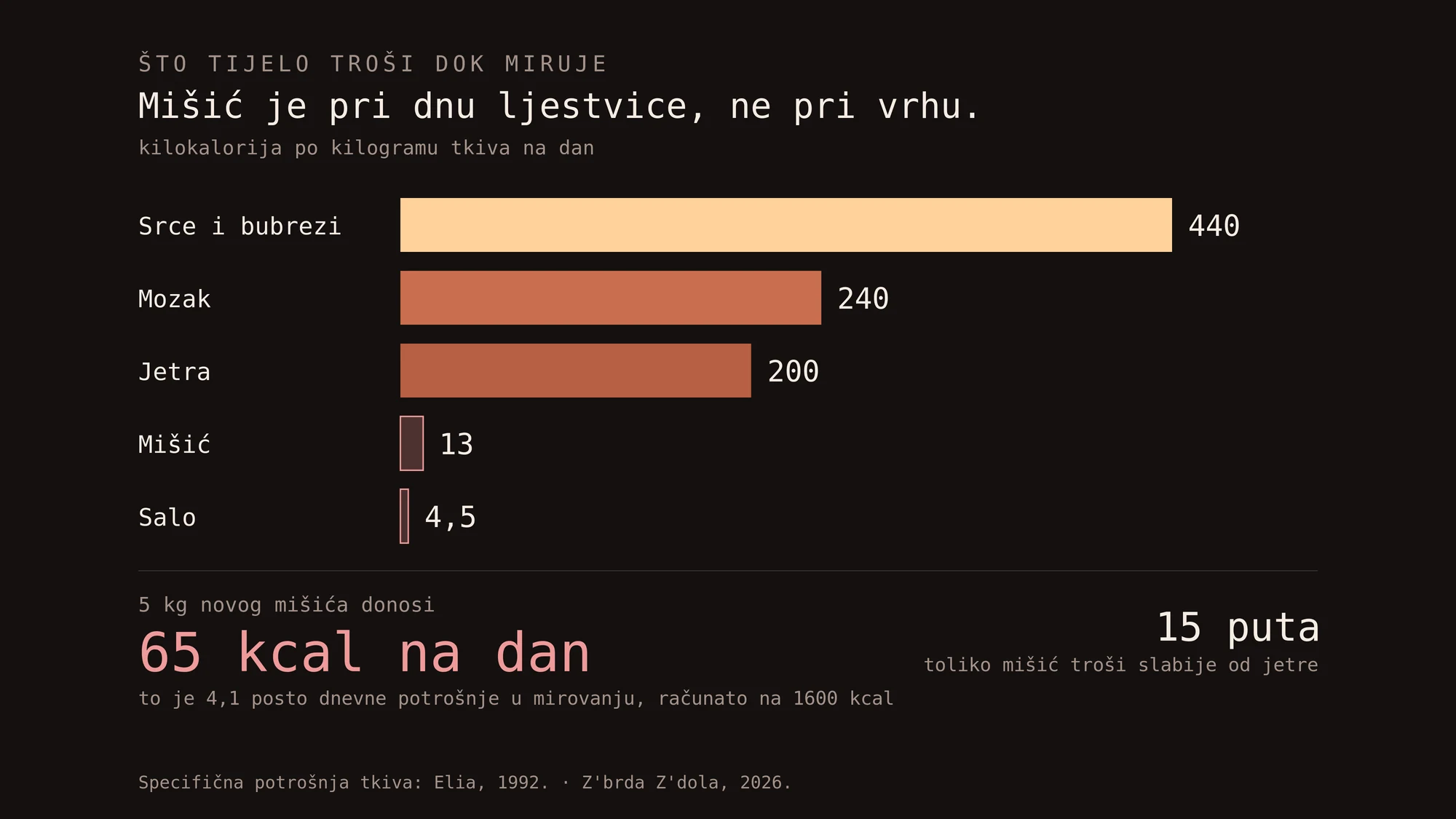
Per kilogram per day, heart and kidneys burn 440 kilocalories, the brain 240, the liver 200, muscle 13 and fat 4.5. Five kilograms of new muscle, which is serious work, brings 65 kilocalories a day. Against a resting expenditure of 1,600 kilocalories that is about four per cent, roughly one slice of bread.
So why is lifting heavy worth it? Because a contracting muscle pulls sugar out of the blood without any insulin. Contraction opens the same door insulin otherwise has to open, which is why an ordinary walk lowers blood sugar in people whose insulin works poorly.
Muscle is also what you carry, climb and stand up with, and after fifty it is harder to keep, because the same meal drives less building. How much protein that takes, and why it is better split across three meals, we set out separately.
Sleep, and a number that is hard to forget
One short night changes hormones by the next day, but not in the way it usually gets retold. The journal Sleep published a measurement in which cortisol was 37 per cent higher after a shortened night and 45 per cent higher after a night without sleep at all. Except that this was found only in the evening, between six and eleven, while daytime levels stayed as usual.
A week of short sleep is another story again. In the same laboratory, ten young men slept five hours a night for eight nights. Their daytime cortisol did not move, and their daytime testosterone fell by ten to fifteen per cent.
It is worth stopping to do the arithmetic. If age takes one to two per cent of testosterone a year, then a week of five-hour nights takes as much as five to fifteen years normally take. Ten men is a small sample, and they were young and healthy, so it cannot be carried over to everyone.
A night does not only go wrong by being short, either. Why we wake around three in the morning, and why that usually has nothing to do with stress, we explained on its own.
What in the video did not survive checking
Sten Ekberg’s video, which set this off, explains the mechanism well and is worth watching. Several things in it we could not confirm, and one we found pointing the other way.
He argues that cardio at 140 to 170 beats does the opposite of what is expected because it raises cortisol. The review of fifteen trials above says the reverse, and that is the form of exercise that took off the most visceral fat. Then, that sugar from fruit is the same thing as table sugar, which a follow-up of 187,000 people does not support. And that snacking is a myth while the eating window is the answer, which a full year in the New England Journal of Medicine did not show.
His sleep figure misses in both directions: he says 25 to 30 per cent more cortisol the next day, and more than that was measured, but only in the evening. In the last five minutes the video turns to the claim that our cells listen to the conversation we hold with ourselves, and that can be neither checked nor disproved. An electrolyte and a course on reading blood work are sold alongside it, so it is worth knowing where he pushes hardest and why.
What is left of all this
If you take one thing from this, let it be that the number on the scale after fifty no longer says what it said in your thirties. Fat and muscle move in opposite directions and cancel out in the same figure, so the change shows on the belt before it shows on the scale.
What has been measured to help is neither new nor expensive. Long easy movement with a few harder stretches in it, something heavy twice a week, a full night, and less processed food. The only new thing is that the margin is no longer what it was at thirty, and that the same lapse now takes longer to pay off.
This is not medical advice. If you have reason to watch your blood sugar or your hormones, that is a conversation for a doctor, not for an ingredient list or a video.
video
links
- JCI Insight, body composition through the menopause transition (SWAN) ↗
- Journal of Clinical Endocrinology and Metabolism, testosterone over the years ↗
- European Journal of Endocrinology, what weight loss does to testosterone ↗
- PLoS One, 15 trials on exercise and visceral fat ↗
- New England Journal of Medicine, the eating window over a year ↗
- BMJ, fruit and diabetes risk in 187,000 people ↗
- European Journal of Clinical Nutrition, fructose and fatty liver ↗
- Circulation, linoleic acid across 30 cohorts in 13 countries ↗
- Sleep, cortisol after one night without sleep ↗
- JAMA, a week of short sleep and testosterone ↗
- Dr. Sten Ekberg, the video this piece started from ↗