Z'BRDA Z'DOLA since 1998
HR

Z'BRDA

Life

Money, work, the head, everyday life. The things that concern everyone and are rarely written about without something for sale at the end. No gurus, no courses, no „five habits of successful people" - only what can be checked.

Edited by Nino Ciglenečki and Iris.

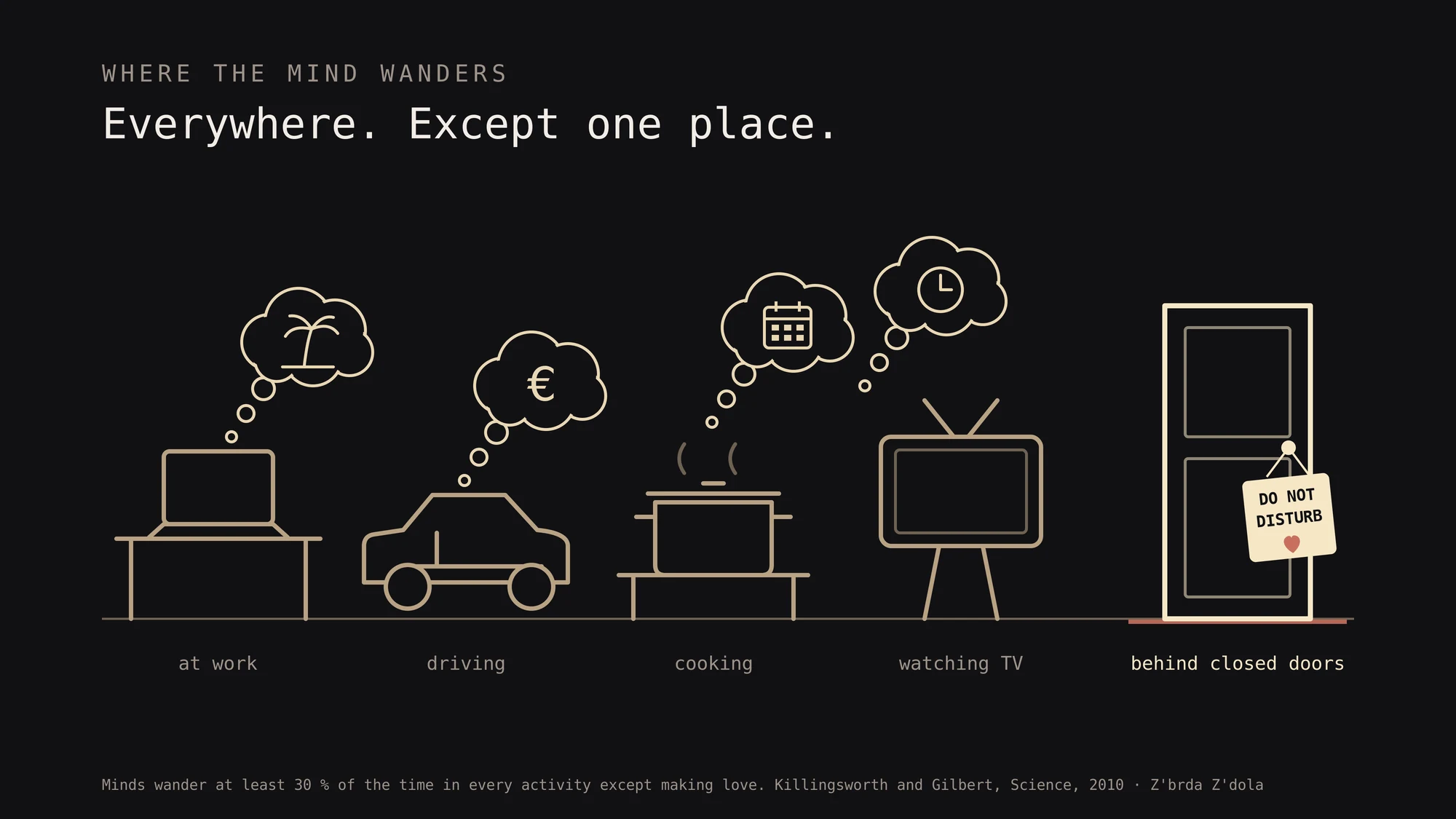
The mind wanders everywhere, except behind closed doors - our drawing

2 October 2026 · Nino Ciglenečki & Iris

The eternal now: why life always starts tomorrow

We wait for Friday, for the holidays, for retirement, and meanwhile life goes by. Harvard psychologists measured that we spend almost half our waking time somewhere else in our heads, and that it does not make us any happier.
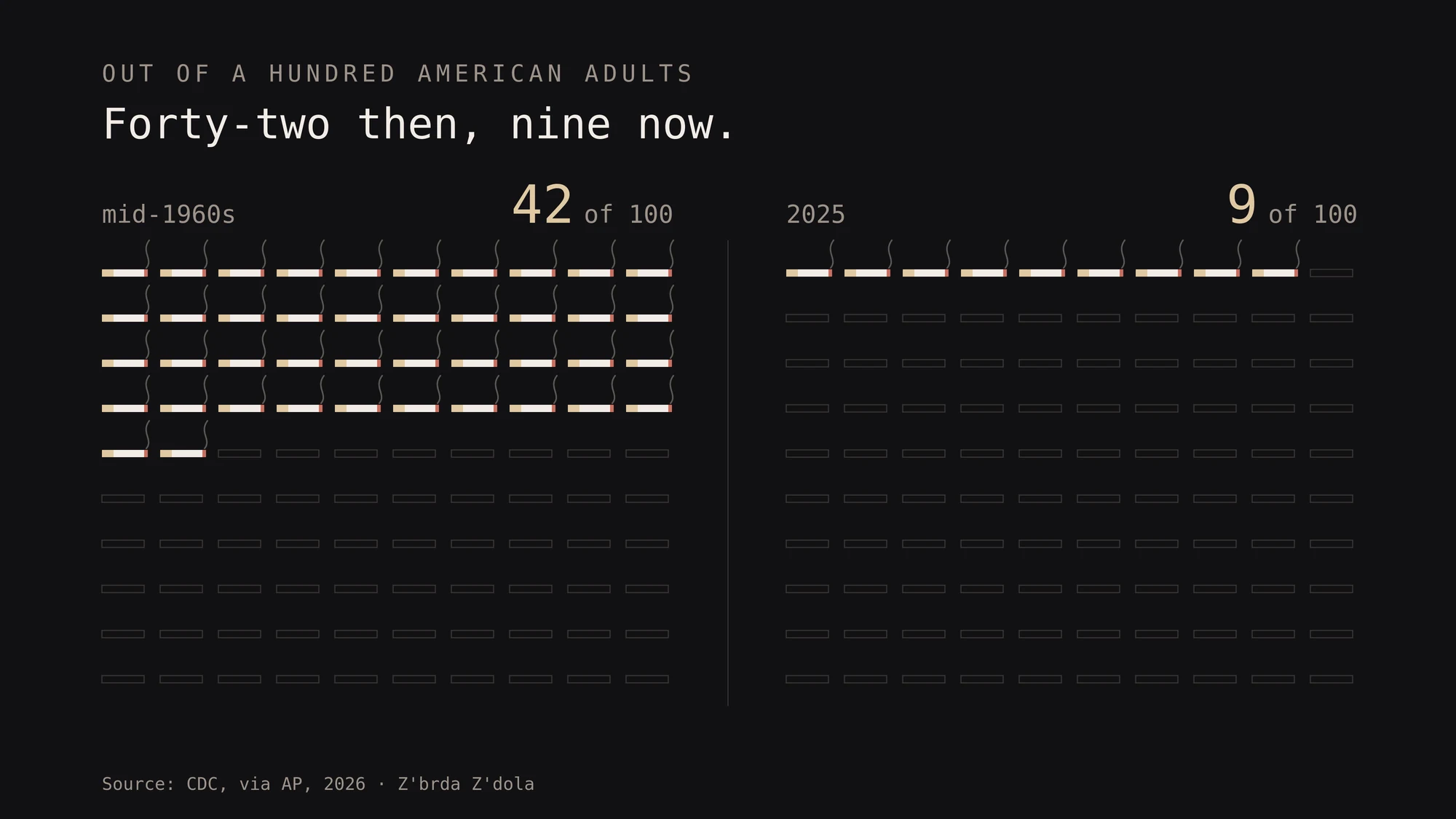
Out of a hundred American adults, 42 smoked in the mid-1960s and nine in 2025 - our drawing

30 September 2026 · Nino Ciglenečki & Iris

The last cigarette on stage

Pat Smear lit a cigarette while Nirvana were accepting an award, and people talked about it more than about the award. Once nobody would even have noticed, because everyone smoked - on stage, outside school and on planes.

channels we recommend

Pursuit of WonderEinzelgängerThe School of LifeAlan WattsDaily StoicRyan HolidayBig ThinkTEDMatt D'AvellaMark MansonSimon SinekMel RobbinsThe Diary of a CEOJordan B. PetersonOrion TarabanSadia PsychologyChase HughesTom LaHueTodd PerelmuterTae Kim

fact checked

  • PAŽNJA ZLATNE RIBICE

    A GOLDFISH ATTENTION SPAN - you often hear that the human attention span has fallen from 12 seconds in 2000 to eight, less than a goldfish's nine. In 2017 the BBC programme More or Less traced the figure to a 2015 report by Microsoft Canada, which had simply taken it from a website called Statistic Brain. The sources that website lists found no record of any such research, and psychologist Gemma Briggs of the Open University says an „average attention span“ depends on the task and is not measured that way. The goldfish is not to blame either: for decades scientists have used goldfish precisely to study learning and memory, because they do both learn and remember.

    1 Oct 2026

    BBC, More or Less on the attention span myth ↗

  • BILJEŠKE RUKOM

    NOTES BY HAND - you often hear that material sticks much better when notes are written by hand rather than typed. The claim goes back to a well-known 2014 paper, which Urry and colleagues repeated in 2021 in the journal Psychological Science with 145 students. Typed notes were longer and copied the lecture more word for word, and word-for-word copying went with lower scores, but on a quiz straight after the lecture the difference between writing by hand and typing was small and not statistically significant. Students were not allowed to review their notes before the quiz, so it remains open what would happen if they had studied from them.

    25 Sep 2026

    APS, the replication on longhand and laptop notes ↗

  • 10.000 SATI

    10,000 HOURS - self-help books often repeat that mastering anything takes 10,000 hours of deliberate practice. A meta-analysis by Brooke Macnamara and colleagues, published in Psychological Science in 2014, covered 88 studies with 11,135 participants. Practice explained about 26 percent of the differences in performance in games, 21 percent in music, 18 in sports, 4 in education and less than 1 percent in professions. Practice matters, but the rest of the differences come from factors that practice alone does not cover.

    24 Sep 2026

    Psychological Science, meta-analysis of deliberate practice ↗

  • SMIJEH KAO LIJEK

    LAUGHTER AS MEDICINE - a Norwegian study of 53,556 people followed for fifteen years did find a link between a sense of humour and survival, but not the one that gets retold. Only one component of humour showed it, the cognitive one, meaning the ability to see the funny side. The social and affective components showed nothing. In women, mortality from heart disease was about 70 per cent lower, and mortality from infections was lower in both sexes. Overall mortality in men showed no difference. This is an observation, so the association is visible while the cause is not proven.

    21 Sep 2026

    Psychosomatic Medicine, fifteen years of follow-up in the Norwegian HUNT study ↗

What is measured, and how firmly. Not advice.

unbelievable but true

  • 862 KILOMETRA U ŠEST DANA

    862 KILOMETRES IN SIX DAYS - it reads like a typo, but it is not. Mario Čeliković from Slavonski Brod covered 862.066 km at the six-day running World Championship in Balatonfüred and took silver among the men. That is 143 kilometres a day, a little over three marathons every day, six days running. He improved the Croatian record by about a hundred kilometres.

    15 Sep 2026

    The official race results ↗

Sounds made up. It is not, and here is where to check.

one interesting thing

  • BALLMER INSTITUT

    BALLMER INSTITUTE - on 23 September 2026 the magazine of the Association for Psychological Science described a University of Oregon programme that is the first in the US to train bachelor's graduates to work on children's behavioural and mental health. Alongside their coursework, students complete 700 hours of supervised practice, and the first cohort graduated in spring 2026. Nevada in 2025 and Oregon in 2026 created a separate licence for them, so they work in schools, primary care and communities under the supervision of licensed professionals.

    24 Sep 2026

    APS Observer, training a youth behavioral health workforce ↗

  • AI I TINEJDŽERI

    AI AND TEENS - on 15 September 2026 psychologist Anne Maheux of the University of North Carolina wrote in the magazine of the Association for Psychological Science about how chatbots are changing growing up. According to the Common Sense Media surveys she cites, roughly two in three American teenagers use chatbots and more than half regularly talk to AI companions, something their parents know far less about. She warns that a companion that is available at any hour and answers instantly takes away the effort through which young people learn relationships, independence and how to handle their emotions.

    24 Sep 2026

    APS Observer, coming of age with AI ↗

  • MALE STVARI KOJE NEŠTOZNAČE

    SMALL THINGS THAT MEAN SOMETHING - on 22 September 2026 the Association for Psychological Science highlighted a paper by Yilin Liu and Fan Yang in Psychological Science, with four experiments on children aged 4 to 9 and on adults. Participants built shapes from puzzle pieces, and when they knew their work would be kept rather than destroyed, they liked the game more, wanted to play it longer and were even willing to pay for it. Even the fact that the game was fun did not fully make up for their work being destroyed afterwards, so the authors conclude that we need a sense of meaning at every age.

    23 Sep 2026

    APS, the study on how much it matters that something lasts ↗

  • SUOSJEĆANJE PREMA SEBI

    COMPASSION FOR YOURSELF - a survey of more than 1,200 Canadians, published in Personality and Individual Differences, sorted people into six profiles according to how much compassion they show towards others, towards animals and towards themselves. Those who showed it in all three directions fared best. The surprising group is the one with plenty of compassion for others and little for themselves: anxiety, depression and lower wellbeing turn up more often among them. This is a survey, so it shows an association rather than a proven cause.

    21 Sep 2026

    Personality and Individual Differences, the paper on compassion profiles ↗McGill, the announcement from the university where the work was done ↗

section archive - older news and older articles →