Z'BRDA · HEALTH
Morning light and mitochondria: why the sun changes your blood sugar and your eyesight
14 September 2026 · Nino Ciglenečki & Iris · hrvatski
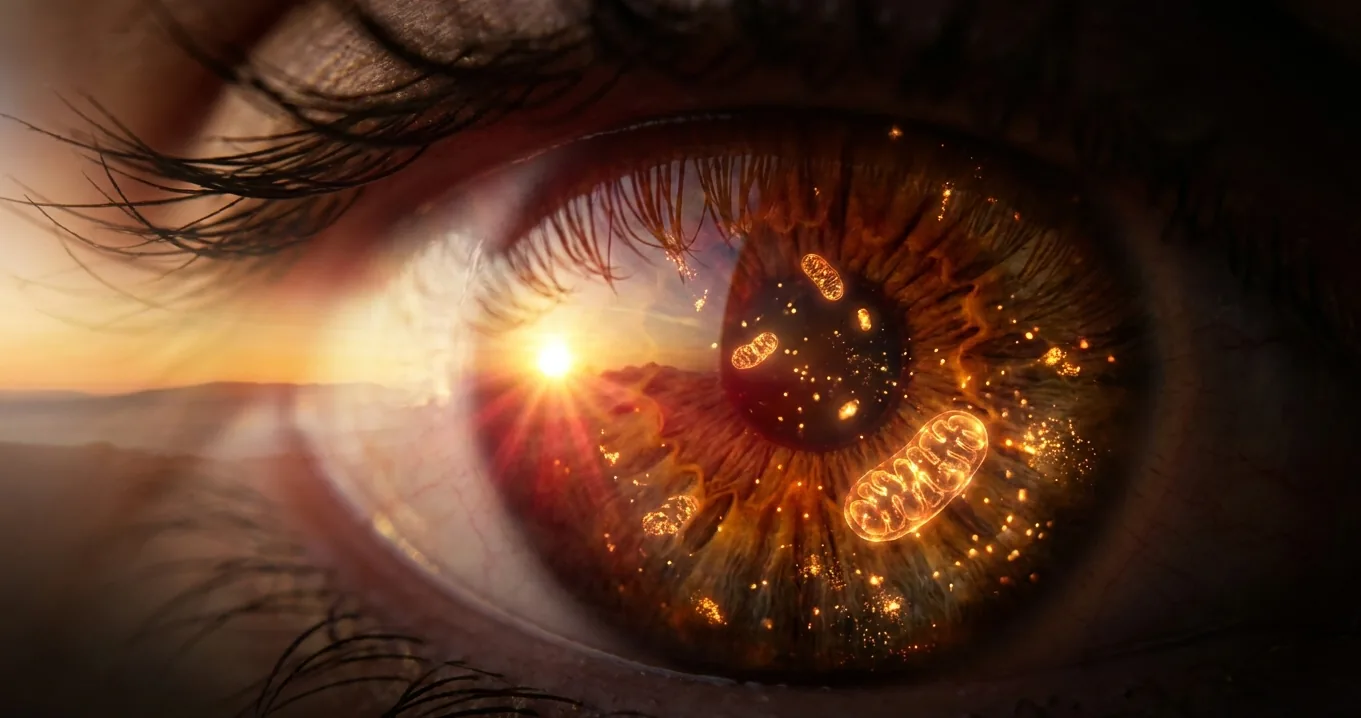
Getting out into morning light is not only about waking up. The long wavelengths of red and near-infrared light reach deep through the skin, switch on the mitochondria and change how the body handles glucose.
The first hour after waking usually goes by in the half-dark of the bathroom, with a screen glowing in your hand while you wait for the coffee to do its job. We take that fog in the head to be a matter of hours slept or of habit, and we treat the light fittings in our flats as a full substitute for daylight.
But laboratory measurements show that putting your eyes and skin in early natural light does not only set the biological clock - it also changes the way your mitochondria handle glucose.
The mechanism starts in the eye, though not in the cells you see shapes and colours with. The retina holds a separate set of photosensitive ganglion cells that respond to particular wavelengths and send nerve fibres straight into the suprachiasmatic nucleus, the master clock in the brain. When the sun sits low on the horizon early in the morning, atmospheric scattering takes the edge off the UV, and what dominates the spectrum are the longer yellow, orange and red wavelengths. That ratio of light triggers a nerve pathway to the adrenal glands and produces an early, healthy cortisol peak. A cortisol peak at the right hour matters: it starts the immune system up, steadies the metabolism, and makes sure the stress hormone drops low enough in the evening for you to fall asleep.
The most interesting part of this physiology, though, happens a long way from the brain. The long wavelengths of natural light, red and near-infrared in particular, go deep into human tissue. A trial run at City, University of London and UCL, on thirty healthy volunteers, found that fifteen minutes of 670-nanometre red light aimed at the back during an oral glucose tolerance test brought total glucose after the drink down by 27.7 percent, and the peak spike itself down by 7.5 percent. A photon of red or infrared light enters the cell and changes the way the electron transport chain in the mitochondria runs. That makes cellular energy production more efficient and lowers oxidative stress.
What these wavelengths do to the retina is just as interesting. Photoreceptors are among the most metabolically active cells in the whole body and carry the densest concentration of mitochondria anywhere. In a trial on twenty-four people aged 37 to 70, a single three-minute look into deep red light in the morning improved colour contrast detection, and the improvement held for a week. In younger subjects there was no such effect. This is one measurable slice of vision, not a prescription being handed back - but it is still more than anyone would expect from three minutes of a red bulb.
Light at the wrong hour runs the other way. In a large analysis of UK Biobank data, close to 85,000 people wore a light sensor for a week and were then followed for eight years: those exposed to the most light at night carried roughly a fifty percent higher risk of developing type 2 diabetes than those exposed to the least. Screens and room lights in the evening are nowhere near bright enough to drive a healthy morning cortisol peak, but they are more than bright enough to disturb the evening production of melatonin.
Fortunately there is a simple counterweight. Stepping out into natural dusk light lowers how sensitive your eyes are to the blue glow of a screen later on. Even on an overcast winter day the photon count outdoors dwarfs the strongest indoor lighting, and green leaves reflect and scatter infrared on top of that.
And tomorrow morning, rather than spending your first minutes under a strip light or in front of a cold screen, step outside into daylight for a few minutes and let your cells get on with it.
The occasion for this piece was a video on the Diary Of A CEO Clips channel. What is written here does not rest on it but on the papers linked below.
links