Z'BRDA · SCIENCE
One flash in a mine: have we finally caught dark matter?
22 September 2026 · Nino Ciglenečki & Iris · hrvatski
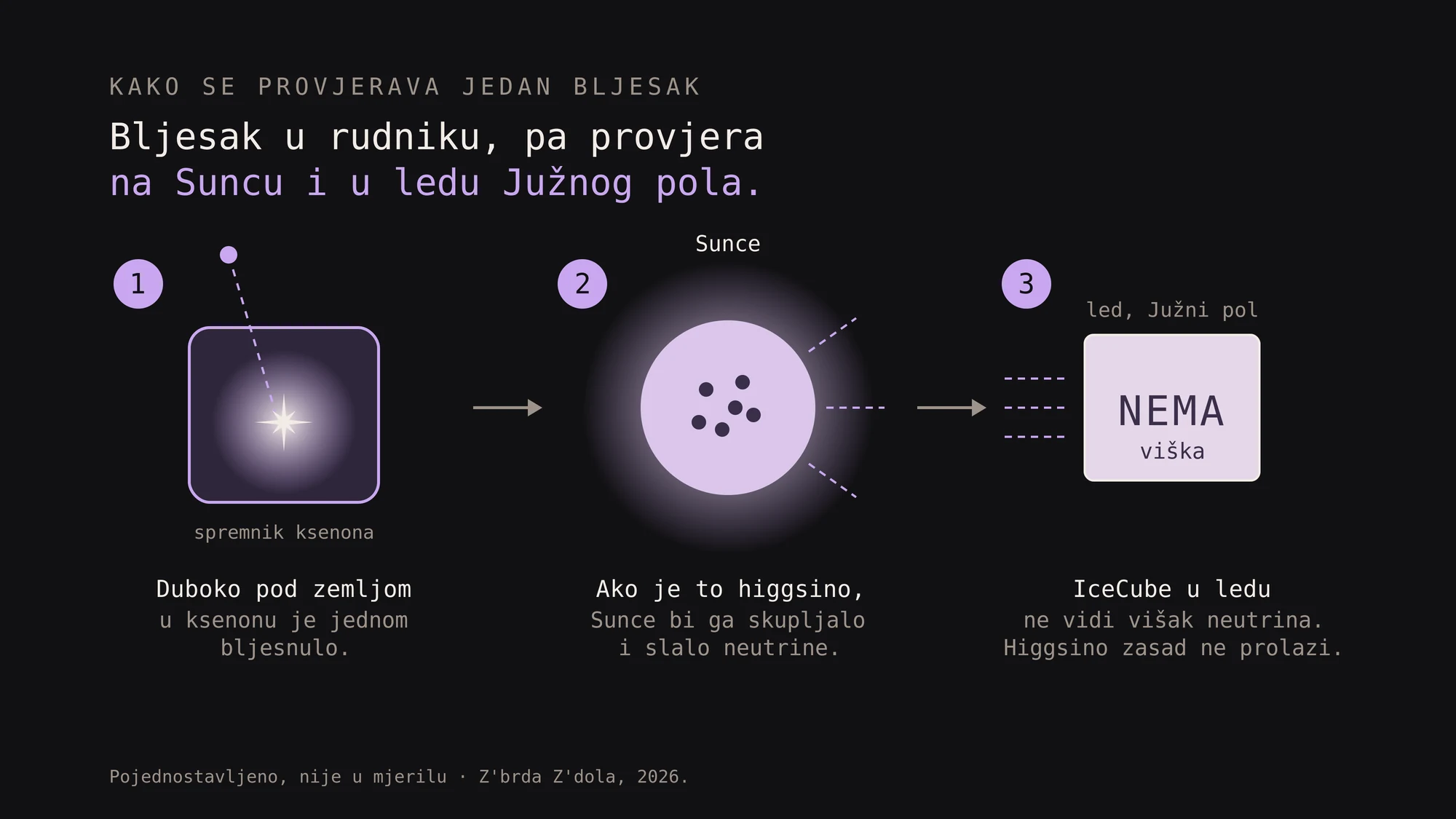
A detector deep underground recorded a single flash that might be dark matter, and physicists rushed to explain it. The most interesting explanation got its first test within a week, and part of the answer came from the ice at the South Pole.
You know that night when you hear a single click somewhere in the house in the dark, and you lie awake waiting for a second one that never comes? From one sound you cannot tell whether someone is at the door or the wood is just shrinking in the cold, so you stay somewhere between fear and laughter.
Physicists hunting for dark matter have been living through that kind of night these past weeks. This piece started from a conversation on the StarTalk channel with Katherine Freese, a physicist who has spent her whole career on dark matter.
The physicist who was among the first to explain that flash said straight away how her idea could be knocked down, and only six days later someone checked.
Dark matter is our name for whatever holds galaxies together. Stars at the edge of our Milky Way move so fast that they would fly apart without some extra gravity holding them. Everything we can see, stars, planets and gas, is nowhere near heavy enough for the job. There is almost six times as much of this invisible stuff as ordinary matter, yet it does not shine or reflect light, and it passes through us as if we were not there.
To catch it, physicists went deep underground. In an old gold mine in South Dakota, about a mile below the surface, sits the LUX-ZEPLIN detector, a large tank of liquid xenon. The rock above shields it from the radiation from space that would spoil the measurement. The idea is simple: when a dark matter particle hits the nucleus of a xenon atom, the nucleus recoils and the xenon briefly glows, and sensitive light sensors catch the flash.
On 16 June 2023 they caught one such flash, and a stronger one than experiments like this usually look for. By their reckoning, all the ordinary sources of noise together should have produced only a hundredth of a flash that strong, and they got a whole one. One flash is not proof, and they know that better than anyone, but it was enough to send physicists around the world to their calculations.
Among the first were Katherine Freese and her student Dionysios Theodosopoulos, who wrote their paper on it in 24 hours. They proposed that the flash was left by a Higgsino, a hypothetical heavy cousin of the famous Higgs boson, more than a thousand times heavier than a proton.
Why that one? In a collision the Higgsino would not simply bounce off like a billiard ball, it would have to get over a small step, like the one at a doorway. Slow particles get stuck at that step and nothing happens, and only the fastest get across and hit hard. So the detector would stay silent for a long time and then flash rarely but strongly, just as it did that June.
In the same breath Freese said how her idea could be tested. If such particles fly through the Earth, they also fly through the Sun, which would slowly catch them and gather them at its centre. When two of them meet there they destroy each other, and in the process they produce neutrinos, tiny particles that pass through almost anything and easily reach us.
Two large detectors catch such neutrinos, IceCube buried in the ice at the South Pole and Japan’s Super-Kamiokande. Six days after her paper, a group of physicists around Debajit Bose went through those detectors’ measurements and calculated that a Higgsino of the kind that would explain the flash does not fit them. One gap remains: that calculation assumes dark matter moves through the galaxy the way we usually think it does, and if it moves differently, the story is not over yet.
So the answer will come from new data, not new calculations. LUX-ZEPLIN keeps measuring, and Freese says other similar detectors, XENON and China’s PandaX, can look for the same flash, which have not searched for flashes that strong before. If the flash was real, it should happen again.
Next time you hear a single click in the dark and wait for a second, remember you are not alone: tonnes of xenon deep under South Dakota are waiting for the same thing. The full conversation between Neil deGrasse Tyson and Katherine Freese is on StarTalk, and there is more there.
video
links