Z'BRDA · SCIENCE
Why a flame gives off heat: energy is not stored in chemical bonds
20 September 2026 · Nino Ciglenečki & Iris · hrvatski
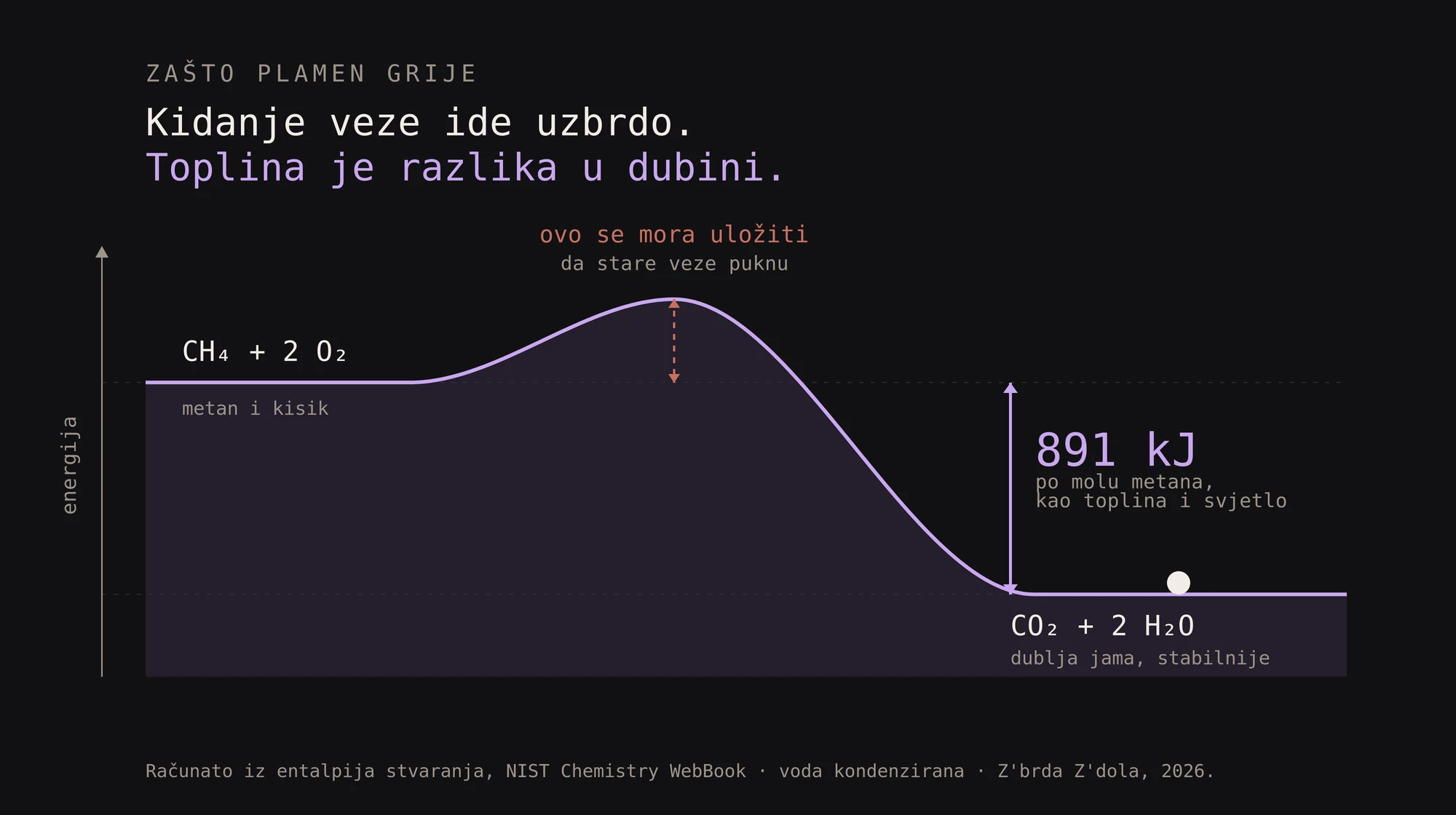
We all learned at school that energy sits stored inside chemical bonds and is released when the bonds break. Breaking a bond always costs something, and the heat comes from somewhere nobody thinks to look.
You watch the flame on the hob while the coffee brews, or you pour petrol into the car, and you think those tiny hydrocarbons are carrying compressed fuel packed into little chemical bonds. Every textbook repeats the same sentence: energy is stored in chemical bonds, and when the bonds break it is released. It sounds reasonable, because the flame burns, the engine hauls tonnes of metal, and your body draws the power for every movement out of breakfast.
Bonds do not store energy inside themselves like little batteries. They are wells that electron waves settle into, and the heat you feel is the difference in depth between those wells.
The first and biggest misconception is about breaking a bond. Pulling two bonded atoms apart always costs something, without exception, because you are working against the force holding them together. Picture a marble resting at the bottom of a bowl: to get it out you have to push it uphill, and that is work, and atoms are no different. So how does burning methane in gas, or petrol in an engine, release so much heat?
The answer is that the reaction does not only break old bonds, it also makes new ones, and the new ones are more stable and lie deeper. When hydrocarbons and oxygen rearrange into carbon dioxide and water, the new compounds drop into a well far deeper than the one they started in. That difference in depth has nowhere else to go, so it turns into motion: molecules speed up, rotate and collide with their neighbours. We feel those collisions as heat, and the excited particles give off photons we see as flame.
Why do these wells exist at all, and why do atoms stop at one particular distance from each other? This is where quantum mechanics comes in. Electrons are not little balls circling the nucleus like planets round the Sun; they behave as waves. Just as a guitar string can only vibrate in certain patterns, an electron wave exists only in permitted states. When two atoms come close, their waves overlap and rearrange into a new pattern that spans both atoms at once. At one particular separation, which we call the bond length, that pattern has the lowest energy it can have. Squeeze the atoms closer and the nuclei push apart; pull them further and the attraction drags them back. The molecule settles at the bottom of that valley and stays there.
The same thing holds for what goes on in your cells. You often hear that ATP works as cellular currency and gives up its power when its phosphate bond is broken, but there too the breaking is a cost, not a gain. The reaction of ATP with water releases energy because what is left, ADP and free phosphate, is more stable and sits in a deeper well than ATP itself.
The scale of that work is hard to picture. In a single day the body breaks down and reassembles roughly as much ATP as it weighs, which is tens of kilograms. None of it is carried around in advance, because that would be like hauling a second copy of yourself around. From oxygen consumption, physiologists worked out that Khalid Khannouchi, who set the world record in Chicago in 1999, remade around sixty kilograms of ATP in a little over two hours. His body assembled it as he ran, one molecule at a time, by letting atoms drop into deeper wells.
All of that chemical energy, in the engine and in the food alike, is borrowed starlight. Using photons made by fusion in the Sun, plants pushed atoms uphill into the less stable arrangements we call sugars. When you eat a meal or light a fire, all you do is let them slide back down.
So there is no canister of compressed power in the petrol or in the breakfast. There are only atoms sitting higher than they would like to, waiting for a chance to come down. Everything else, the heat, the light and every step you take, is the difference between those two heights.
video
links
- Arvin Ash, the video this piece started from ↗
- Chemical bond, the quantum mechanical account ↗
- Potential energy surface, the wells molecules sit in ↗
- BioNumbers, daily ATP turnover in humans ↗
- NIST Chemistry WebBook, the formation enthalpies the heat was computed from ↗
- PNAS, the body remakes roughly its own weight in ATP each day ↗