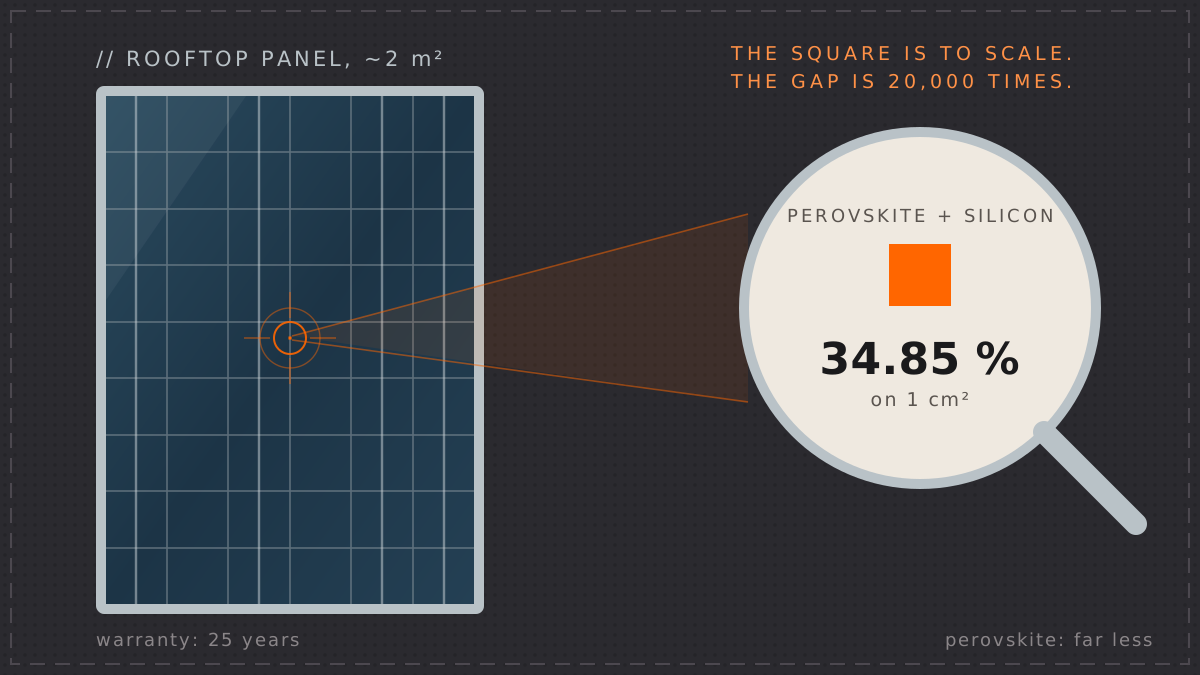
The record you can't buy
Solar cells have broken through a ceiling silicon will never reach. Then you see how big the record piece is and how long it lasts - and the story gets much better.
Science · ARCHIVE
Everything that has moved off the section page over time. Nothing is deleted - a news item or an article simply stops being the first thing you see.
articles 2026
Solar cells have broken through a ceiling silicon will never reach. Then you see how big the record piece is and how long it lasts - and the story gets much better.
fact-checked
LEFT BRAIN AND RIGHT BRAIN - popular psychology sorts people into left-brained analytical types and right-brained creative ones. Brain scans of 1,011 people aged 7 to 29, published in PLOS ONE, found nobody who used one hemisphere more than the other as a lasting trait. Lateralisation is real but local: a particular connection may be stronger on the left or the right, while the brain as a whole is neither left nor right.
20 Sep 2026
PLOS ONE, the original paper on brain lateralisation ↗
MOZART EFFECT - it has been widely claimed for decades that listening to Mozart's music boosts cognitive abilities and permanently increases IQ in children and adults. A comprehensive meta-analysis published in the journal Intelligence, analyzing 39 independent studies with a total of 3,011 participants, proved that Mozart's music does not enhance general intelligence or spatial reasoning. Researchers explain that the observed short-term test boost stems solely from temporary arousal and mood elevation, which can be achieved through any enjoyable stimulation.
14 Sep 2026
PubMed, abstract of the meta-analysis in Intelligence ↗
VITAMIN D AND COLDS - it is widely claimed that daily high-dose vitamin D supplementation prevents colds, flu, and respiratory tract infections in the general population. A systematic review and meta-analysis show that vitamin D reduces the risk of acute respiratory infections by only eight percent overall, but this effect is significant exclusively in individuals with severe clinical vitamin D deficiency. In healthy individuals with normal blood levels, additional supplementation provides no measurable protection against viruses.
10 Sep 2026
TEN PERCENT OF THE BRAIN - it is often claimed that humans use only a small fraction of their brain and that unlocking the rest could lead to superhuman abilities. Functional magnetic resonance imaging and neurological measurements confirm that humans use 100 percent of their brain throughout the day, and even during deep sleep, almost all parts show measurable activity. Science clearly rejects this myth, confirming that every part of the cerebral cortex has a known function and there are no unused neurological reserves in the human body.
9 Sep 2026
LUNAR PHASES AND SLEEP - It is widely claimed that a full moon disrupts sleep, makes falling asleep harder, and causes insomnia, often blamed on water pull in the body or ancestral instincts.
In practice, a controlled laboratory study by the University of Basel published in Current Biology monitored the brain activity of 33 volunteers, recording a 30 percent drop in deep-sleep brain activity, a five-minute increase in time to fall asleep, and a 20-minute reduction in total sleep time along with lower melatonin levels. Another study in Science Advances tracking hundreds of people in both urban and rural environments using wrist actimetry confirmed that individuals go to sleep 30 to 80 minutes later and sleep 20 to 90 minutes less on nights leading up to a full moon, suggesting our natural circadian rhythms remain synchronized with the lunar cycle.
8 Sep 2026
What has been measured, and how firmly. Not advice.
older news
ISOLDE - on 22 September 2026 CERN announced that, during the third long shutdown of its accelerators, it is rebuilding the line that carries the beam from the Proton Synchrotron Booster to the ISOLDE facility. Until now the protons arrived there at 1.4 GeV, and after the work they will arrive at 2 GeV. A stronger beam means more exotic isotopes, the rare versions of atoms that ISOLDE produces and studies. Ten magnets have been taken out of the line so far, among them dipoles weighing eight and a half tonnes each.
23 Sep 2026
CERN, the upgrade of the line to ISOLDE for a 2 GeV beam ↗
FIRE AMOEBA - on 22 September 2026 NASA reported on the amoeba Incendiamoeba cascadensis from Lassen Volcanic National Park in California, which reproduces at 63 °C and stays active up to 64 °C. The previous limit for eukaryotes, cells with a nucleus like our own, was 60 °C. The amoeba is single-celled, and it survives the heat by giving its DNA and proteins extra protection. The study was published in Cell and led by Beryl Rappaport of Syracuse University.
23 Sep 2026
NASA, the amoeba that lives at 63 °C ↗
ENTANGLED Z BOSONS - on 17 September 2026 the ATLAS and CMS collaborations published strong evidence that Z bosons produced by the decay of a Higgs boson are quantum entangled. Entanglement has mostly been seen in low-energy particles, and two years ago it was observed at the LHC in top quarks. The Z boson is a harder case because it has three possible spin states instead of two, so it is measured indirectly, through the pairs of electrons or muons it decays into. CERN speaks of strong evidence rather than confirmation, which in particle physics is one step lower.
21 Sep 2026
CERN, the announcement on Z boson entanglement ↗
CHANDRA - the X-ray telescope has found 84 objects of a kind never seen before, in Andromeda, the Pinwheel galaxy and four others. They have been named hypersoft X-ray sources because they give off unusually low-energy X-rays while at the same time radiating strongly in the ultraviolet. They turn up both where stars are being born and where the stars are old. The paper is published in Nature Astronomy, and the authors think these objects could explain where Type Ia supernovae come from, the ones used to measure the expansion of the universe.
20 Sep 2026
Chandra, the release on hypersoft sources ↗
NASA - at around noon on 14 September 2026, above the French village of Cessy, the Moon passed in front of Venus in broad daylight. A single exposure caught both as crescents: the Moon lit only about ten percent, Venus about twenty-five. Venus was still the brighter of the two because it sits closer to the Sun and its clouds reflect more light than the dark lunar surface. An occultation of Venus like this is visible from only about ten percent of the Earth, and this time most of that was in daylight.
20 Sep 2026
NASA, the Astronomy Picture of the Day ↗
NASA - the agency announced on 14 September 2026 the selection of 12 new scientific investigations aimed at supporting human crews during long-duration space missions. Six of the selected projects will look at ways of growing crops off Earth, while the other six examine the biological impact of the space environment and radiation on astronaut health.
15 Sep 2026
NASA, the release on the new investigations ↗
ESA/HUBBLE - a giant ten-sided wave has been found in the atmosphere around Saturn’s south pole, the first regular shape of its kind ever seen in the planet’s southern hemisphere. Saturn’s northern hexagon has been known for more than forty years, and the Cassini probe found nothing like it in the south across thirteen years in orbit. Amateurs first spotted it in ground-based images in 2024, and Hubble images from the OPAL programme showed it faintly present as far back as 2023. The wave sits in a jet stream and extends through several layers of the atmosphere, so it is not just cloud; the paper is published in Science Advances.
15 Sep 2026
ESA/Hubble, the release on Saturn’s decagon ↗
CERN - scientists at the NA64 experiment in the North Area initiated a major upgrade of their detector system and particle beams on September 4, 2026. Following a decade of hunting for dark photons and light dark-sector particles by measuring missing energy, the upgrade will support up to a hundredfold increase in beam intensity and data collection. The enhanced setup will enable more precise probes of hypothetical particles that could bridge visible matter with the invisible mass of the universe.
14 Sep 2026
CERN, on a decade of hunting the dark sector ↗
ESA - The European Space Agency successfully completed the world's first targeted reentry of its remaining Cluster satellites Samba and Tango on September 1, 2026. The ROSIE airborne mission flew out from Tonga to record the spacecraft's breakup over a remote area of the South Pacific Ocean, capturing rare data on atmospheric reentry. This scientific milestone will help engineers design more sustainable satellites that burn up entirely at the end of their lifespan.
8 Sep 2026
SOUTH CHINA NORMAL UNIVERSITY - Physicists announced on August 26, 2026, the first direct laboratory test of Feynman's path integral postulates using single photons. Utilizing an advanced optical setup, the research team reconstructed approximately 1,419,857 distinct optical paths and measured their wave propagators. The experimental findings matched Feynman's 1942 theoretical formulation with high precision, finally verifying this cornerstone of quantum mechanics in a controlled laboratory setting.
8 Sep 2026
South China Normal University ↗
FIRESHIP - The artificial intelligence model Mythos 5.1 was successfully trained on September 1, 2026, using thirty-year-old NASA radar data. The system was utilized to build a new elevation map for a part of the planet Venus. This demonstration highlights the capability of advanced neural networks to process historical astrophysical datasets.
7 Sep 2026
CHINESE ACADEMY OF SCIENCES - Scientists published measurements on September 1, 2026, showing that the decline in star formation is not caused by a simple depletion of gas in galaxies. Using the FAST radio telescope, an international team measured neutral atomic hydrogen across 2.5 million galaxies and found that its density decreased by only about thirty percent over the past 4.5 billion years, while the rate of star birth fell to less than half. The decline in star birth is instead linked to a reduced efficiency in converting atomic hydrogen into the molecular gas needed to incubate stars.
5 Sep 2026
UNIVERSITY OF PORTSMOUTH - the building blocks of rocky planets could have started forming as early as 100 million years after the Big Bang, long before the first galaxies. Simulations led by Daniel Whalen show that the explosions of the first, enormously massive stars scattered carbon, oxygen and iron into the surrounding gas, so that a disc around a star about 70 per cent the mass of the Sun could gather enough solid material for several Earth masses of planetary building blocks. The disc also held water, only a few times less than the disc our own Solar System formed from. The paper is published in The Astrophysical Journal Letters.
3 Sep 2026
JEFFERSON LAB - looking to confirm the mysterious Y(2175) state with a photon beam, physicists ran into two new structures instead. The GlueX Collaboration in Hall D fired a high-energy photon beam at a proton target and found Y(2240) at a mass of about 2.24 billion electronvolts, at five sigma, and X(1830) at 1.82 billion, at three sigma. Both belong to the XYZ family of states that do not fit the model of a particle made of two or three quarks. The paper is published in Physical Review Letters.
3 Sep 2026
LZ - the LUX-ZEPLIN dark matter detector, nearly a mile underground at the Sanford Underground Research Facility in South Dakota, has recorded a single unexplained particle interaction that could be a trace of a WIMP, a dark matter candidate. The finding was presented on 1 September 2026 at a particle physics conference in Japan, based on 220 days of data collected between March 2023 and April 2024, and its statistical significance of 2.6 sigma remains below the 5 sigma threshold required for a confirmed discovery. The paper by Sam Eriksen and colleagues goes to arXiv and to Physical Review Letters.
2 Sep 2026
ROMAN - on 30 August 2026 at 7:26 a.m. EDT, NASA launched the Nancy Grace Roman Space Telescope on a Falcon Heavy rocket from pad 39A at Kennedy Space Center. Ahead of it are three months of travel to the L2 point, about 1.5 million kilometres from Earth. Roman surveys the sky a thousand times faster than Hubble and will send back 1.4 terabytes a day, the highest rate of any NASA astrophysics mission so far. It will look for dark matter, dark energy and exoplanets, and NASA expects the first images in early 2027.
2 Sep 2026
S301 - astronomers have found a star orbiting the Milky Way's central black hole at 25,000 km/s, passing closer to it than any star observed before, at roughly the distance from Saturn to the Sun. It was detected with the GRAVITY+ instrument on ESO's VLTI in Chile, its next close passage is due in 2031, and its tight orbit makes it the first star that could be used to measure a black hole's rotation directly.
1 Sep 2026
LKH - measurements of 39 globular clusters within the inner 20,000 light-years of the Galaxy revealed a third, previously unrecognised group that came from a dwarf galaxy swallowed about 11.8 billion years ago. That galaxy held some 500 million solar masses in stars, and the finding pushes the known history of the Milky Way 1.8 billion years further back.
1 Sep 2026
SN 2023aeaf - the COSMOS-Web survey with the James Webb telescope turned up a supernova at redshift z=3.195, among the most distant with a measured spectroscopic redshift. Two imaging epochs about a month apart in the rest frame classify it as a likely Type II supernova, and the data best match a progenitor of roughly 12 solar masses in a low-metallicity galaxy.
1 Sep 2026
MARS - the interior of the southern hemisphere is 200 to 400 °C warmer than the northern half, and partly molten. That is the finding of an analysis of gravity measurements from three orbiters, published in Nature on 27 August 2026 and led by Alexander Berne of Caltech. It matches an earlier InSight observation that seismic waves fade faster in the south.
31 Aug 2026
EMPTY SPACE IS NOT EMPTY - over more than 140 hours of observing the magnetar 1E 1547-5408, the IXPE satellite measured X-ray polarisation of 40 and 80 per cent, nearly three times higher than in comparable sources. The explanation that fits is vacuum birefringence (a magnetic field this strong turning empty space itself into a kind of lens), an effect predicted in 1936 and never directly seen. The paper is in Nature.
31 Aug 2026
EARLY GALAXIES - nine huge galaxies from the young universe hold three to four times more mass than thought, because a crowd of small, faint stars hides among the rare bright ones. The measurement was made with the James Webb telescope and the VLT, and the paper appeared in Nature Astronomy on 18 August 2026. It was led by Mariska Kriek of Leiden; one of those galaxies formed less than one and a half billion years after the Big Bang.
31 Aug 2026