Z'BRDA · SCIENCE
The perpetual motion machine that breaks no law
8 September 2026 · Nino Ciglenečki & Iris · hrvatski
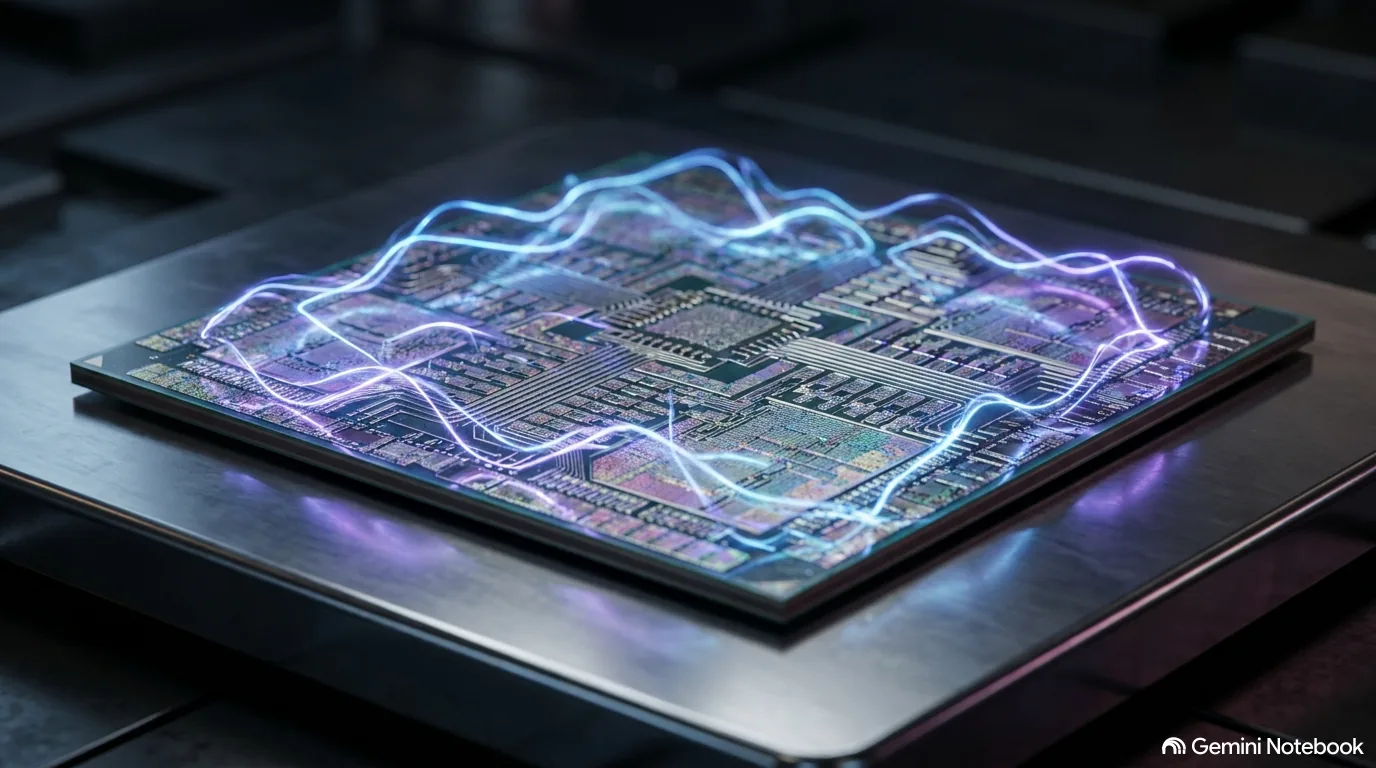
We spend our lives believing that all motion requires fuel and eventually comes to a halt. The physics inside our atoms says the exact opposite.
You turn off your computer. The fans slow down and stop, the screen goes black, and everything inside that piece of plastic and metal looks as if it has finally come to a halt. Our entire everyday experience of the world tells us that all motion requires some kind of fuel, battery, or spring, and that everything must eventually stop the moment that energy reservoir is depleted. The macro world we touch operates on a principle of constant friction, where loss is the default state and effort is always required to keep things moving.
However, deep inside every atom of that same cooled processor, electrons are constantly moving and never, not even for a fraction of a second, stop - and they consume absolutely no energy to do so.
The usual explanation we carry from primary school is actually completely wrong. We imagine electrons as tiny, hard spheres obediently orbiting the massive nucleus of an atom, much like planets orbit the sun. But this classical model hides a fatal mathematical flaw. According to the laws of classical electrodynamics, any accelerated motion of a charged particle - and orbiting is indeed accelerated motion - must result in the continuous radiation of electromagnetic waves. This means that as long as the electron orbits, it must lose energy every single second. A shocking physical calculation shows that in this classical scenario, every electron would lose all its kinetic energy and crash into the nucleus in less than a hundred billionth of a second. Atoms would collapse into themselves before they could even form the first stable molecules, and our physical world simply could not exist in any recognizable shape.
The actual physical mechanism that holds our universe together is completely different and far stranger. The electron is not a hard, localized sphere with a fixed path. It behaves as a standing wave wrapped around the nucleus of the atom. Just as a guitar string can only vibrate at specific frequencies corresponding to its length, an electron can only exist in states where its wavelength fits perfectly around the circumference of its orbit. A wave compressed into such a microscopic, confined space of barely a fraction of a nanometer simply cannot rest by the very definition of wave motion.
This inability to rest is directly linked to the fundamental uncertainty principle. The universe imposes an absolute and insurmountable limit: we can never simultaneously know a particle’s exact position and its exact momentum. If we were to try to perfectly stop and hold an electron in one place, its momentum would have to be zero, meaning we would know its position with infinite precision. To satisfy the uncertainty relation, reducing the space in which the electron is confined automatically generates a massive uncertainty in its velocity. The more we try to squeeze and calm the electron within the narrow atomic shell, the more the very geometry of space forces it into increasingly violent vibration.
This continuous, unavoidable motion is called zero-point energy. It is crucial to emphasize that this is not some mystical fuel poured into the particle from the outside, nor is it a perpetual motion machine breaking the laws of thermodynamics. It is a pure, cold geometric necessity of space itself. The electron moves not because something is constantly pushing it or charging it, but because the structure of our quantum universe does not allow it to be perfectly located and perfectly still at the same time. Confinement here does not mean imprisonment that dampens and stops - confinement is what generates and continuously sustains motion.
And in the morning, when you turn your computer back on and hear that familiar, quiet fan noise trying to cool your processor, remember that nothing inside it ever really rested. All your data, photos, and programs run on the backs of particles that never sleep, keeping your entire world in eternal motion simply because they do not have the right to stop.
If you want to see how the same rule plays out at the very beginning of time, the full lecture is on the The Roger Physics channel.
video
links