Z'BRDA · LIFE
The eternal now: why life always starts tomorrow
2 October 2026 · Nino Ciglenečki & Iris · hrvatski
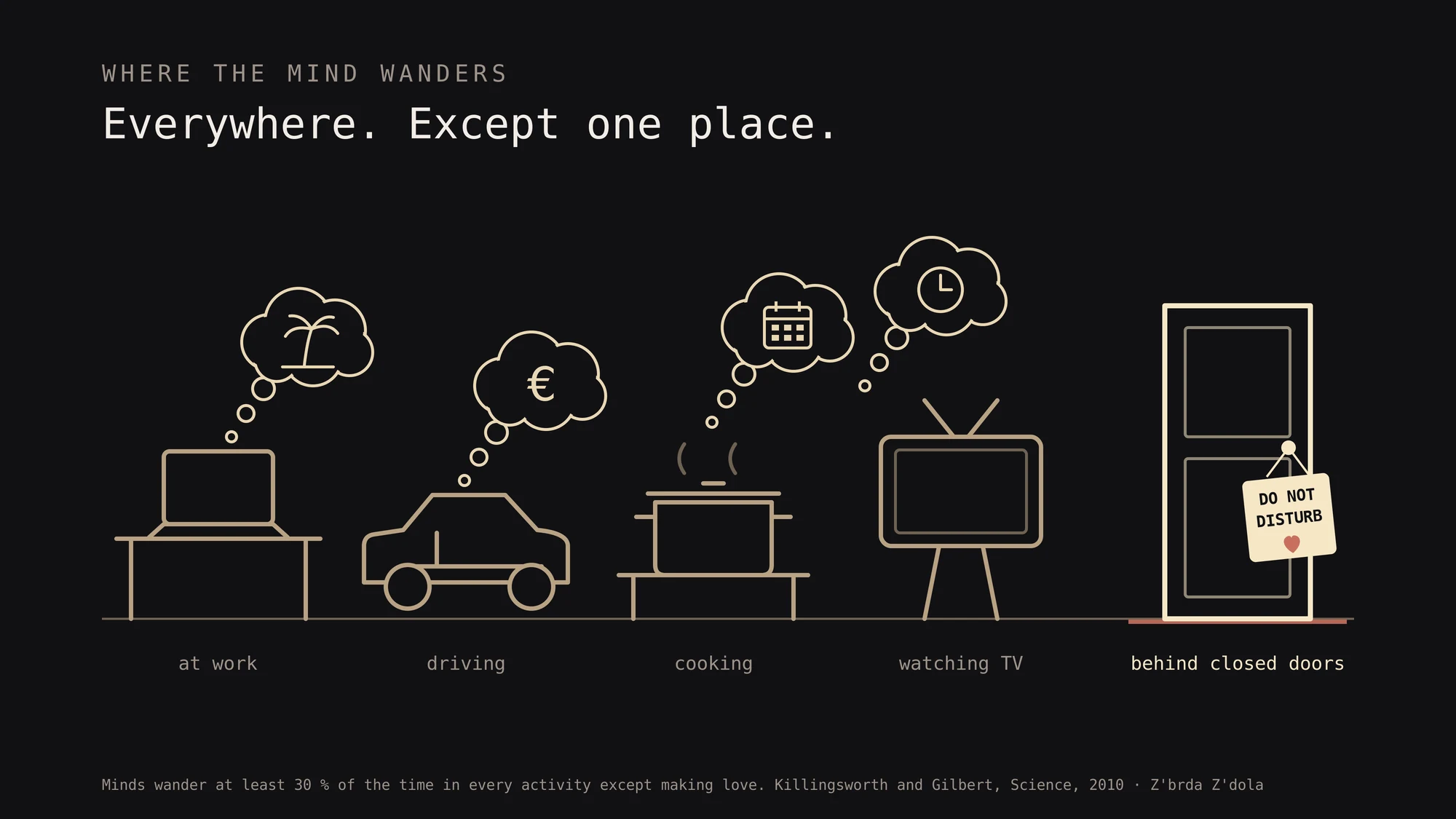
We wait for Friday, for the holidays, for retirement, and meanwhile life goes by. Harvard psychologists measured that we spend almost half our waking time somewhere else in our heads, and that it does not make us any happier.
You know that Monday when by eight in the morning you are already counting the days to Friday, and that Sunday evening when Monday has already started in your head? A week goes by between them that you can barely remember afterwards, and weeks like that add up to years.
Most of us live with a small calendar in our heads on which real life is always booked for some other date. When the holidays come, when the mortgage is paid off, when the kids leave for university or when we finally retire, then we will relax and start enjoying ourselves.
The philosopher Alan Watts called that kind of hope a perfect hoax, and not because what we hope for never happens, but because the waiting keeps us half alive, so we live the present in passing, like a waiting room for something better.
Yesterday, in five lines
Try to remember what you did yesterday. Got up, had coffee, went to work, had lunch, watched a bit of television and went to bed, and that is roughly all that fits into the answer. Yet the day was full of things that never made it in: how the coffee smelled, what someone said to you in passing, what the light was like when you stepped outside,…
Words come one after another and turn a day into a list, but a list is not a day. The trouble starts when we begin living by the list, ticking off one item and already looking at the next, so the day goes by as a set of chores instead of something we actually lived.
It is the same with money. Whoever waits for a number in the bank account to make them happy never gets a big enough one, because every time they reach the goal it moves a little further away.
Half the day we are somewhere else
In 2010 the Harvard psychologists Matthew Killingsworth and Daniel Gilbert wanted to find out how present we really are in our own lives. They built a phone app that asked people at random times of day three things: how they felt, what they were doing and whether they were thinking about it or about something else. Some 2,250 people aged 18 to 88 signed up and sent a quarter of a million answers.
Minds were somewhere else in almost half of waking time. They wandered during everything people did, at least 30 percent of the time, with one single exception, and that was making love.
What came next is more interesting. When their minds drifted to something unpleasant or quite ordinary, people were noticeably unhappier than when they were focused on what they were doing. And when they daydreamed about something pleasant, they were no happier than when they were not daydreaming. Escaping into a nice thought, then, brings nothing more than what we would have had if we had not escaped at all.
In short, whether people’s minds were on what they were doing affected their mood more than what they were actually doing. On top of that, wandering mostly came before a bad mood rather than after it, so we more often fall into a bad mood because we drifted off than drift off because we are in a bad mood. And then there is the phone, thanks to which we interrupt ourselves every 47 seconds.
Old wisdom, same problem
None of this is a new discovery. The Greek word the New Testament uses for sin, hamartanein, originally means to miss the mark, as when an archer misses the target. Watts read it literally: the mark is life, and we miss it by always being somewhere else.
A similar idea turns up in a famous speech by Jesus. In the Gospel of Matthew, one of the four books about the life of Jesus, he speaks to a crowd gathered on a hill, which is why that part is called the Sermon on the Mount, and in the middle of it he tells them to look at the wild flowers. The flowers do not work, do not buy clothes and do not worry about what to wear, and yet they are better dressed than King Solomon, a ruler famous for his wealth and splendour. The message is simple: do not worry about tomorrow in advance, because each day has enough worries of its own.
Watts joked that people skip this advice with the excuse that Jesus had it easy, since his father was the boss of the whole universe, while the rest of us have to be practical. The good news, he says, was exactly that we are all children of that same boss, only word of it never got around.
Once I get myself sorted
The most common reason we put life off sounds perfectly sensible. First I will lose weight, stop getting worked up, sort things out at work and at home, and then I will live more calmly and enjoy it.
Watts called this fighting fire with fire. We try to earn peace with the very restlessness we are running from, so when one item is dealt with the next one takes its place, and the moment when we are finally ready never arrives.
Getting back, as far as you can
Nobody can live only in the present, and there is no need to try. We plan, we save and we look forward to a trip, and that is fine. The trouble starts when plans and worries about tomorrow stop us being here today. On holiday we think about work, at work we think about the holiday, and so we are never fully in either place.
What helps is simple, and that is why it is easy to forget. Do one thing at a time: drink your coffee without the phone, walk without headphones, eat lunch without the news. When you notice you have drifted off, do not be angry with yourself, just come back, because by noticing you have already come back.
And if you do not know how, listen for a moment to what you can hear around you. Not a single sound you hear at that moment is from yesterday or from tomorrow, and that is the shortest way back to now. In the evening, instead of the list of what you got done, recall one moment of the day that you really lived.
Next time someone asks you what you did yesterday, notice how much shorter the list is than the day. And if this has intrigued you, the video is worth hearing to the end, because half the story is carried by Watts’s voice.
video
links