Z'BRDA · LIFE
Is this essential? A Roman formula against digital fatigue
5 September 2026 · Nino Ciglenečki & Iris · hrvatski
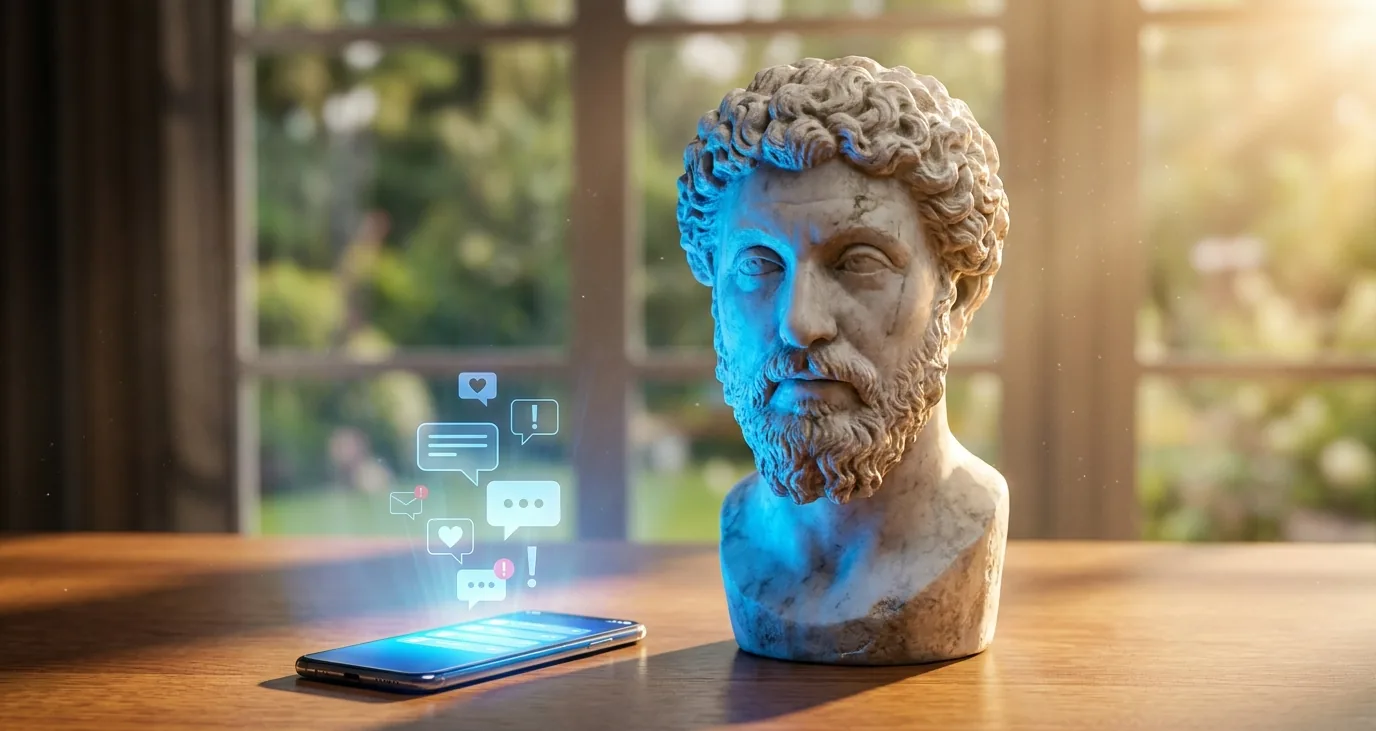
We interrupt ourselves every 47 seconds, even without notifications. A Roman emperor and modern psychology offer the exact same, incredibly simple solution.
You sit down at your desk, open a blank document, and pause for a second to think about the first sentence. In that brief window, without any ringtone or vibration from your pocket, your hand moves toward your phone entirely on its own. You unlock the screen, open an app, scroll through a few posts, close it, and put the phone back on the desk. When you look at the blank paper in front of you again, you realize you have absolutely no idea why you just did that.
The usual explanation for this constant distraction is simple - we live in a fast-paced world, we are overwhelmed with work, and we must multitask to get everything done. Multitasking is presented to us as a necessary skill of the modern worker, and our need to constantly keep up with information is interpreted as a desire for better organization and efficiency. We believe we are distracted because technology is constantly pulling us by the sleeve, bombarding us with notifications we cannot ignore.
However, studies show that in almost half of all cases, we actually interrupt ourselves completely on our own, driven solely by an internal impulse without any external stimulus. Scientists call this self-interruption. Dr. Gloria Mark, a professor of informatics at the University of California, Irvine, discovered a devastating truth about our attention in her decades-long research. When her team first began measuring screen attention spans in 2004, people spent an average of two and a half minutes on a single window before switching to another. Today, that number has plummeted to just 47 seconds.
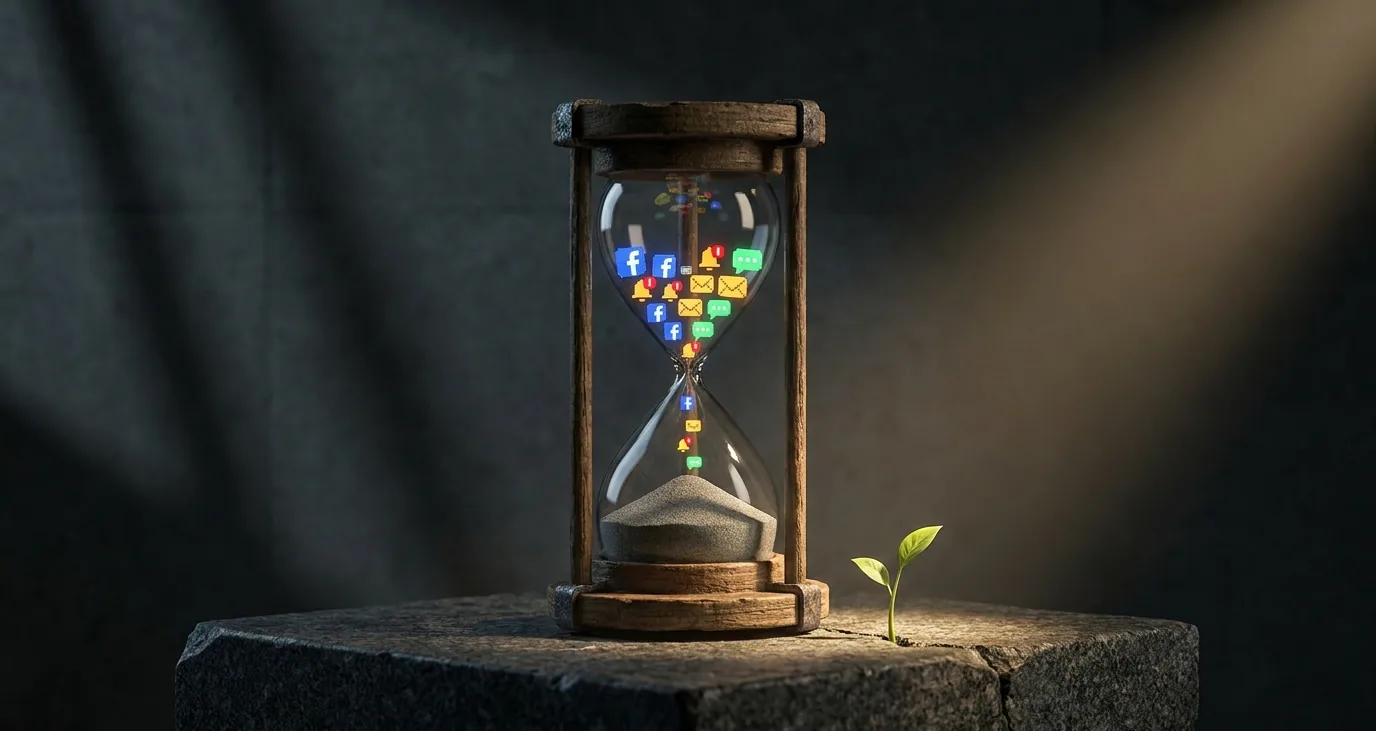
The greatest illusion we live every day is that switching from tab to tab, from email to message, is just a quick and harmless shift of focus. Every time we look away from our main task, even for a second to read a quick notification, we do not continue where we left off. Dr. Mark’s research shows that after just one interruption, it takes an average of 23 minutes to fully restore our mental context and return to the original work. This task-switching process is not free - it rapidly drains our cognitive reserves, increases errors, and causes measurable physiological stress, which is clearly visible in increased blood pressure and a drop in heart rate variability.
Interestingly, this exact same mechanism was recognized nearly two millennia ago, without the help of algorithms and smartphones, by the Roman Emperor Marcus Aurelius. Writing notes to himself in a war tent on the river Danube, he left a record that hits the very center of our modern problem. The Emperor writes that at every moment we should ask ourselves: “Is this essential?” He adds that most of what we do, think, and say is actually not essential, and that by eliminating the unnecessary we gain a double benefit - we do less, but what we do, we do incomparably better. The ancient Stoics knew that our motivation and energy are limited resources that we too easily waste on minor, trivial battles and other people’s opinions, leaving ourselves completely empty for the things that truly matter to us.
This is not something that only happens to others; I find myself falling into this trap all the time. For example, instead of fully enjoying the quiet of my backyard in Zagorje, during those rare moments when I decide to rest a little, my hand instinctively reaches for my phone to do something ‘productive.’
Of course, it was easy for an emperor to write about eliminating the unnecessary in a world where there were no Slack channels, midnight deadlines, and clients expecting an email response within five minutes. Today’s organizational structures and workflows often literally impose attention fragmentation as a condition for workplace survival, meaning we do not always have full control over our time. Dr. Mark’s study also has its limitations, as it was conducted on office workers in a high-tech environment, meaning these results cannot be automatically applied to all types of occupations.
Still, those who manage to preserve even a tiny piece of their peace amidst this digital fatigue do not achieve it through extreme solutions. Dr. Mark points out that digital detoxes are like crash diets - they provide a temporary illusion of change, but afterward, we quickly return to our old habits with an even bigger appetite. Instead, those who control their attention introduce small, sustainable changes. They do this by asking the simple, cold question left to us by the Roman Emperor, right in that brief gap between the impulse in their head and the physical touch of the screen.
And in the evening, when you finally turn off your computer and are left alone in the dim room, your phone will glow on your nightstand again. Before you reflexively pick it up, ask yourself just that one question. My bonus solution is also a very simple action - turning on Airplane mode.
video