Z'BRDA · LIFE
The end of the world we failed to notice and the quiet fade of music as an identity anchor
25 September 2026 · Nino Ciglenečki & Iris · hrvatski
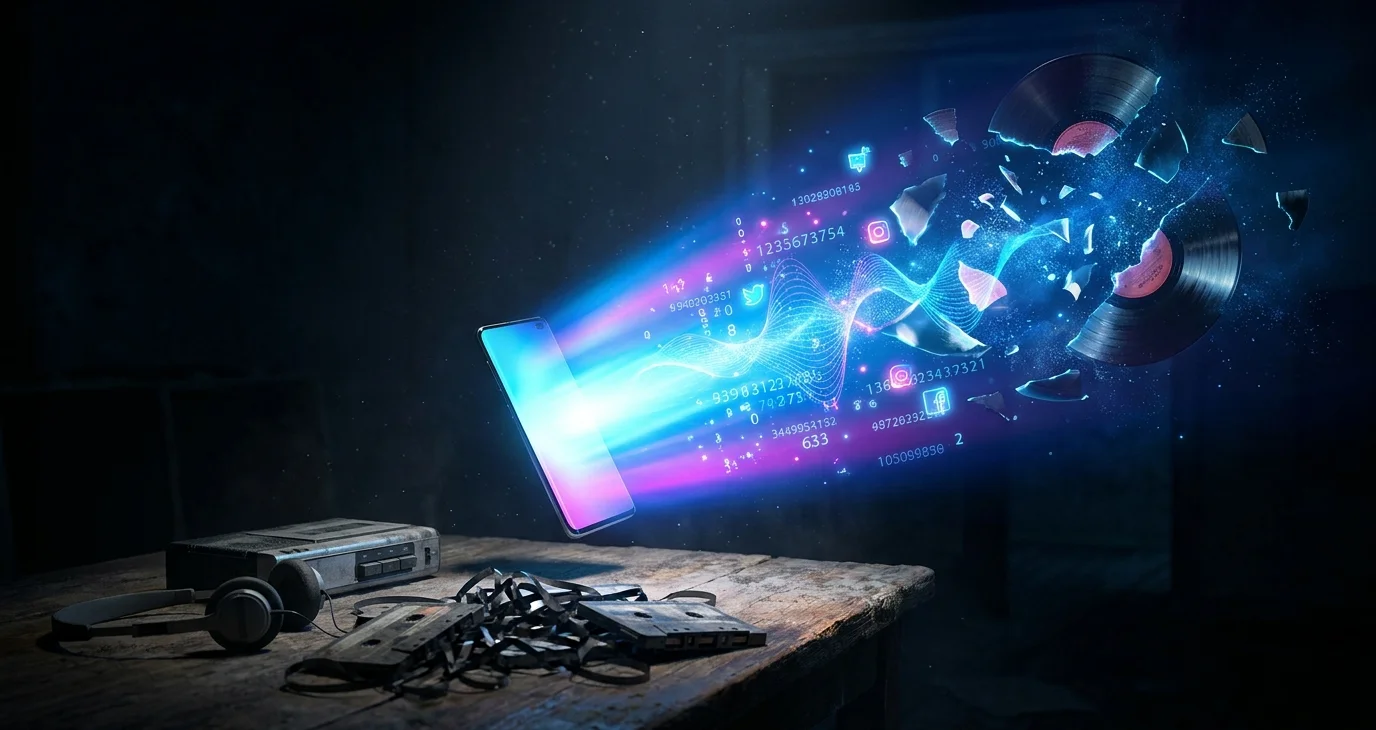
Everyone remembers the infamous Mayan calendar prophecy about the end of the world in December 2012. The real turning point arrived not from outer space, but from mobile networks and algorithms that permanently transformed how we experience music, attention, and memory.
Do you remember those late autumn weeks in 2012 when media and pop culture were endlessly debating the ancient Mayan calendar and the predicted end of the world? That twenty-first of December passed completely peacefully, the earth kept spinning, and most people laughed off another apocalyptic theory. Yet when you look back with temporal perspective at what was happening in technology, culture, and human habits during those exact months, you realize that an old era did indeed end right then, just without spectacular explosions in the sky.
The true collapse of the old world occurred the moment fourth-generation mobile networks and smartphones turned algorithms into a continuous stream of micro-stimuli that displaced music from the core of human identity.
Up until that pivotal year, music served as the primary anchor around which coming-of-age generations built who they were, how they thought, and where they belonged. Visiting local record stores, buying cassettes and CDs with hard-earned allowance, and intentionally listening to a single album from start to finish on a Walkman or Discman required physical effort, time, and total commitment. As early as 1989, Morris Holbrook and Robert Schindler showed that the songs that stick with people most are the ones that were popular in their early adulthood, with a peak around the age of twenty-four. The songs you fall in love with during that period remain your personal acoustic fingerprint for life because they were directly tied to first loves, friendships, and finding your place in the world.
During 2011 and 2012, major mobile carriers rolled out 4G LTE networks at scale. Over the same period the share of American adults with a smartphone jumped from 35 percent in May 2011 to 46 percent in early 2012, and the following year it crossed the halfway mark for the first time. That technological infrastructure suddenly enabled instant high-bandwidth video streaming anywhere at any time, replacing simple casual games with a continuous feed of media streams. With the arrival of infinite digital feeds, the algorithm took over as the primary manager of your attention. Instead of actively listening to forty minutes of a cohesive album while walking through the city or sitting in your room, your brain became exposed to hundreds of rapid micro-dopamine hits in the form of short videos, notifications, and online games.
Losing that dedicated space for listening did not merely reshape the financial streams of the music industry; it altered how your brain constructs memory and experiences surrounding space. You used to memorize dozens of phone numbers of loved ones and mentally navigate city routes without staring at a navigation screen, while every purchased music album served as a temporal journal bringing you back in a second to a specific summer, street, or feeling. When algorithms redirect every spare moment toward continuous scrolling and short-form consumption, music stops being the chief architect of subcultures and personality, turning instead into background noise for other digital stimuli.
This quiet shift explains why younger generations struggle to forge new music movements with the intense social charge once carried by punk, metal, goth, or hip-hop. Members of those movements defined their style of dress, attitudes, and social circles precisely through the music to which they dedicated hours of daily listening. The problem today is not that modern music lacks talented creators, but that the media apparatus stripped away the time, quiet, and concentration necessary for a song to settle under your skin in the first place.
When short videos and algorithmic recommendations take control of leisure time, the brain naturally loses the habit of deep immersion into any complex artistic form. People who grew up with physical media preserve memories tied to concrete objects and sound recordings, whereas younger generations live in a state of permanent attention fragmentation where content rotates faster than it can leave any lasting emotional imprint.
The deepest connections with art, ideas, and other people do not arise from unlimited and instantaneous access to all the world’s information at the touch of a finger, but from intentionally chosen duration. The ability to remain inside a single sound, a single book, or a single thought without reaching for the next rapid click is becoming the most valuable form of personal freedom and spiritual resistance in the digital age.
This piece was prompted by Rick Beato’s video “The World Ended In 2012… We Just Didn’t Realize It”.
video
links
- Rick Beato, The World Ended In 2012... We Just Didn't Realize It ↗
- Pew Research Center, 46 percent of American adults own a smartphone, February 2012 ↗
- Pew Research Center, 56 percent in 2013, a majority for the first time ↗
- Holbrook and Schindler, Journal of Consumer Research, 1989, the development of musical tastes ↗