Z'BRDA · LIFE
Zeitgeist, nineteen years on: the film that asked a good question and gave a bad answer
20 September 2026 · Nino Ciglenečki & Iris · hrvatski
Anyone who watched it in 2007 remembers the feeling. Two hours later the world no longer looked the same. Nineteen years on the claims can be checked one by one, and that is where you see what survived and what never stood up at all.
Anyone who watched Zeitgeist in 2007 remembers the feeling above all. Two hours later the world no longer looked the same, and the sense that you had finally seen behind the curtain stayed with you for days.
That feeling was real even where the film was not, which is exactly why it is worth writing about. The claims can be checked one by one today, while the feeling can be neither disproved nor measured.
The film went online on 18 June 2007 and quickly gathered tens of millions of views. Its author, Peter Joseph, argued that the three pillars holding civilisation up, religion, the state and money, are not what we take them to be. Part one says Christianity was copied from older myths and from astrology. Part two claims that 11 September was an inside job and that three World Trade Center buildings were deliberately brought down with explosives, and part three that the Federal Reserve is run by a handful of bankers who start wars in order to profit from the debt.
When you open the claims up
Take the one that shook people most. The film says the Egyptian god Horus was born of a virgin on 25 December, had twelve disciples, was crucified and rose again after three days. Let us check two of those claims, the two that need no knowledge of Egyptian.
The Egyptian texts describe the conception quite differently. Isis gathers and reassembles the dismembered body of Osiris, revives it enough, and conceives Horus with him, which is roughly the opposite of a virgin birth.
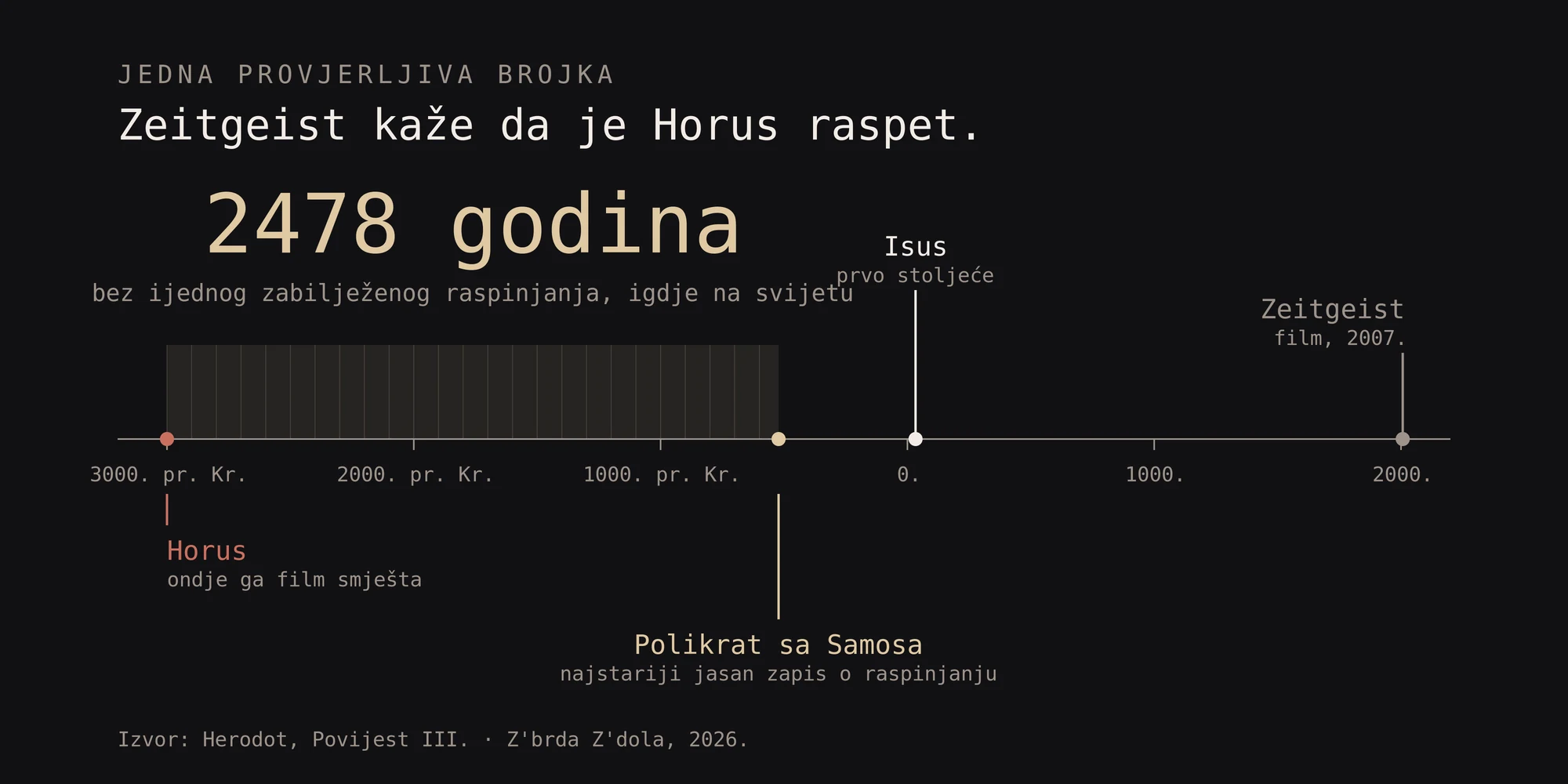
Crucifixion is simpler still. As a method of execution it only appears in the records during the first millennium BC, and the earliest clear mention is in Herodotus, concerning Polycrates of Samos, executed in 522 BC. The film places Horus around 3000 BC, and so has him die on a cross some two and a half thousand years before the earliest crucifixion history knows of.
Part two of the film fares much the same. In 2008 the American standards institute NIST published its final report on WTC 7 and concluded that fire brought the building down, having heated and expanded the steel beams until one key column gave way. Neither explosives nor fuel, the report states, played any part in it.
So why did it work
Because not everything in it was invented. Writing in Skeptic magazine, Tim Callahan noticed the crucial thing: some of the claims do hold, but they are mixed in with half-truths and with material that is simply false. In that mixture the line disappears, and the trust earned by the accurate part carries over to everything else.
Jane Chapman, who teaches media at the University of Lincoln, also showed how it was done: alongside its account of the London bombings the film shows footage of the Madrid ones, counting on nobody checking. Her conclusion is that the film goes for the strongest possible emotion instead of argument, and in doing so it demolishes even those questions that were perfectly legitimate, about 11 September and about corruption in religious and financial institutions. That is the real damage Zeitgeist did, because when the answers fall they usually take the questions down with them. Ivor Tossell summed it up in The Globe and Mail in a few words that still hold: a marvel of tight editing and fuzzy thinking.
Nineteen years on
This September the American personal development coach David Bayer took the film up again and argues that Zeitgeist stopped too soon. It woke people up, he says, but left them in anger, and anger is not a destination, so there is no point tearing down the system until the consciousness that built it has changed.
It sounds reasonable until you look at what the claim rests on. Bayer relies on the so-called map of consciousness, a scale on which every state of mind has its own number, and the numbers come from muscle testing. In 2001 that test was examined in a way that left nobody knowing what they were holding: four examiners tested seven people with a confirmed wasp venom allergy, each of them on ten real and ten dummy bottles. It identified the real allergen in 40 per cent of cases and the dummy bottle in 60 per cent, while a repeat test on the same person could give a different result. The authors concluded that the method is no more useful than guessing.
What is interesting, though, is that one part of Bayer’s account does hold. The loop he describes, in which belief shapes feeling, feeling shapes behaviour, and behaviour produces the outcome that confirms the original belief, is ordinary cognitive psychology, and cognitive behavioural therapy is built on it. A review of 106 meta-analyses published in 2012 concluded that the evidence for it is very strong. So one and the same video carries a checkable claim and an uncheckable one side by side and asks you to take both, which is exactly what Zeitgeist did.
What is left of it all
The question is what is left, and it was better than any answer the film offered. The point is not who runs the world but who decides what we are going to believe, and how we would recognise it if we were wrong.
Something of that shock is left too, which is no bad thing. To stop believing something merely because it comes from a position of power is a healthy instinct, but the same instinct, kept off the leash, just as easily pushes a person to believe anyone who says we are being lied to. So the most useful thing Zeitgeist left us is really the habit it set off in those who watched it and then started checking. You open a claim, look for the source and see whether it holds, which takes a few minutes and is usually more interesting than the film itself.
links
- The Osiris myth, how Egyptian texts describe the conception of Horus ↗
- Crucifixion, the earliest clear record is in Herodotus ↗
- NIST, the final report on the collapse of WTC 7 ↗
- Complementary Therapies in Medicine, the muscle test under double-blind conditions ↗
- Cognitive Therapy and Research, a review of 106 meta-analyses on CBT ↗
- David Bayer, the video this piece started from ↗