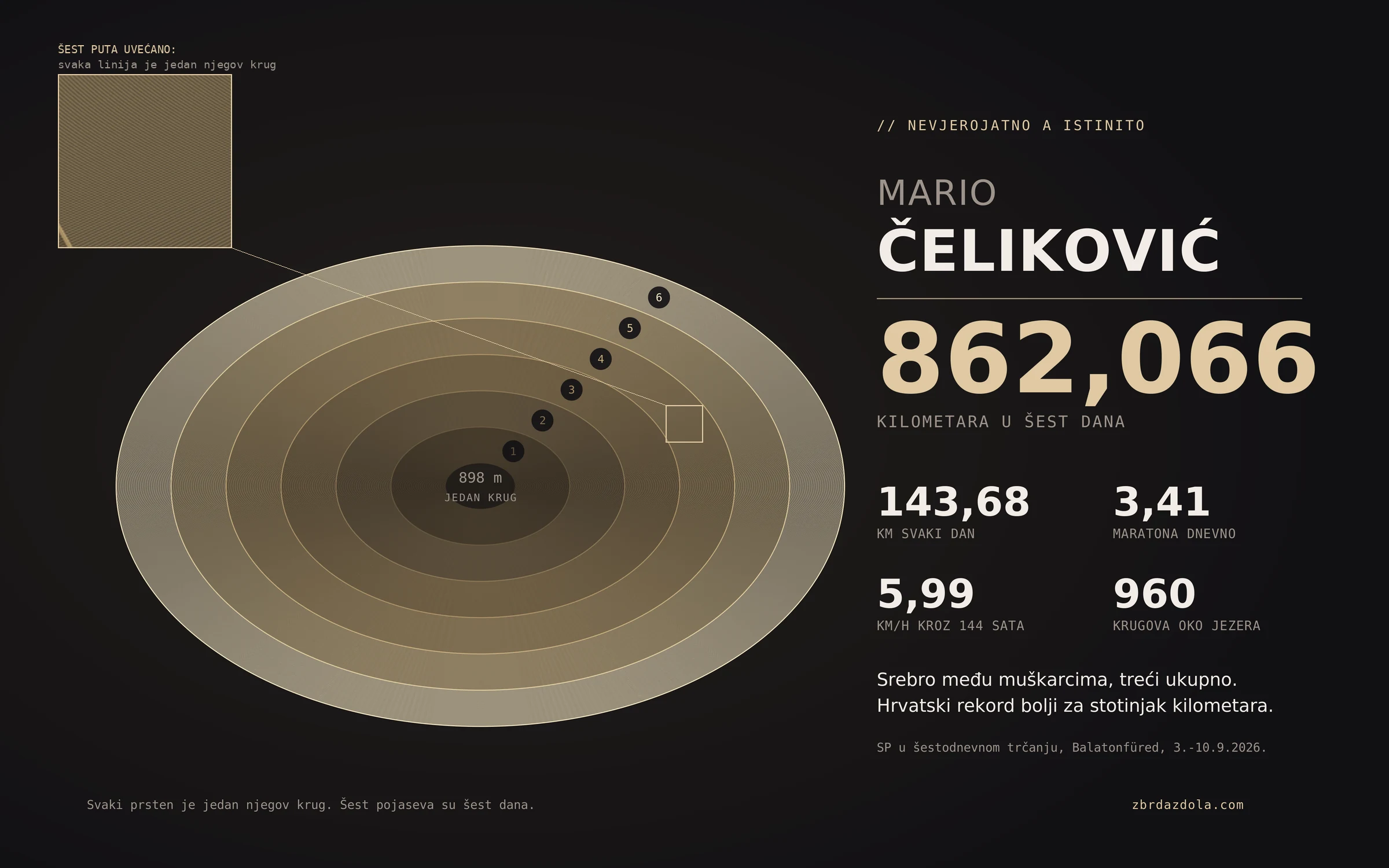
The man of steel: 960 laps of the same lake
Mario Čeliković from Slavonski Brod ran 862 kilometres in six days. His surname means "of steel" in Croatian, which is too good to be a coincidence, and the number is one you first read as a typo.
Life · ARCHIVE
Everything that has moved off the section page over time. Nothing is deleted - a news item or an article simply stops being the first thing you see.
articles 2026
Mario Čeliković from Slavonski Brod ran 862 kilometres in six days. His surname means "of steel" in Croatian, which is too good to be a coincidence, and the number is one you first read as a typo.
Money sitting quietly in an account looks like the safest decision in the world. A Canadian portfolio manager explains why that is a decision too, and why it carries a cost you can calculate.
We interrupt ourselves every 47 seconds, even without notifications. A Roman emperor and modern psychology offer the exact same, incredibly simple solution.
fact-checked
BODY LANGUAGE AND 93 PERCENT - workshops keep repeating that words carry only seven percent of a message and that tone and body language carry the rest. The figure is real, but it comes from Albert Mehrabian’s 1967 experiments in which people heard single words spoken in a tone that contradicted them and had to guess the speaker’s feeling. That is all that was measured: whom to believe when word and tone disagree. It cannot be carried over to ordinary conversation, where content and tone mostly agree.
20 Sep 2026
PubMed, Mehrabian’s original 1967 paper ↗
THE 4-7-8 BREATHING TECHNIQUE - inhale for four, hold for seven, exhale for eight; wellness circles sell it as a switch that instantly turns off anxiety and brings on sleep. In 43 healthy people aged 19 to 25, some of whom had spent a night without sleep, researchers measured what happens immediately after doing it: heart rate and blood pressure fell in almost everyone, rested and sleep-deprived alike. That is a real, measurable effect, but a short-lived one, measured in a small group of young people. The trial says nothing about treating chronic anxiety or insomnia.
15 Sep 2026
Physiological Reports, the original paper on 4-7-8 breathing ↗
BLUE LIGHT - device manufacturers and app developers frequently claim that blue light from smartphone screens is the sole culprit behind sleep disruption and that night filters completely solve insomnia. A controlled clinical study involving 167 participants published in the Journal of Sleep Research showed that enabling blue-light filters yields no improvements in sleep onset latency or sleep duration if the device continues to be used in bed. Researchers emphasize that the primary cause of sleep disruption is cognitive and emotional brain stimulation from screen content, rather than light color alone.
14 Sep 2026
PubMed, abstract of the study in the Journal of Sleep Research ↗
MULTITASKING - it is widely believed that handling multiple tasks simultaneously increases efficiency and allows faster completion of work in a modern business environment. Neurological measurements and cognitive experiments show that the human brain cannot process multiple complex tasks at once but merely rapidly switches attention between them. This switching incurs a cognitive cost that reduces accuracy by 20 to 40 percent, slows overall work, and increases stress hormone secretion.
10 Sep 2026
TEN THOUSAND STEPS - smartwatches and fitness apps regularly impose 10,000 steps as the golden and unquestionable daily standard for achieving longevity. A study published in the journal JAMA Internal Medicine, based on long-term tracking of 16,741 women, showed that significant health benefits begin at just 4,400 steps, and reach their absolute peak at around 7,500 steps per day. After this number, the mortality rate among participants completely levels off, meaning there is no additional biological advantage in obsessively chasing the magical ten thousand mark.
9 Sep 2026
21 DAYS FOR A HABIT - It is a widely held belief that it takes exactly 21 days of continuous repetition to form a new habit or permanently break an old behavior.
In practice, a study led by Dr. Phillippa Lally at University College London (UCL) and published in the European Journal of Social Psychology showed that it takes an average of 66 days to form a habit. Tracking 96 volunteers over 12 weeks, researchers found that the time required for a behavior to become automatic actually ranged from 18 to 254 days, depending heavily on the complexity of the habit. The 21-day myth originated from the 1960 book Psycho-Cybernetics, in which plastic surgeon Maxwell Maltz noted that it took patients a minimum of 21 days to adjust to their new physical appearance, which the self-help industry subsequently misquoted as a universal scientific rule for behavioral change.
8 Sep 2026
What has been measured, and how firmly. Not advice.
older news
THE OLDER BRAIN CHANGES, IT DOES NOT BREAK - on 17 September 2026 researchers at the University of Arizona published a framework in Perspectives on Psychological Science that treats later life as a continuation of development rather than decline. The young brain leans on the hippocampus and remembers detail; the older brain leans on the frontal cortex and remembers meaning. The authors stress that this is not compensation for a loss but a change of priorities, and that the same shift is seen in animals. This is a hypothesis assembled from existing findings, not a new measurement.
21 Sep 2026
Perspectives on Psychological Science, the original paper ↗APS, the announcement about the paper ↗
APS - on 14 September 2026 the Association for Psychological Science published a piece on why psychology still knows most about people who are Western, educated and from rich democratic countries. The argument is not that the samples are bad but that students are never taught how a sample is chosen or when a finding may be generalised. Until that changes, the author says, psychology remains the science of one narrow slice of humanity, the slice nearest to hand.
20 Sep 2026
APS Observer, on samples in psychology ↗
862 KILOMETRES IN SIX DAYS - it reads like a typo, but it is not. Mario Čeliković from Slavonski Brod covered 862.066 km at the six-day running World Championship in Balatonfüred and took silver among the men. That is 143 kilometres a day, a little over three marathons every day, six days running. He improved the Croatian record by about a hundred kilometres.
15 Sep 2026
APS - the Association for Psychological Science published findings on 14 September 2026 from Harvard Business School researchers explaining why online confessions are read so avidly. Experiments by Leslie John showed that sharing personal information and reading other people’s anonymous stories activates the same reward centres in the brain as receiving money or eating a favourite food.
15 Sep 2026
APS, the article on the psychology of confession ↗
APS - a paper in Nature, featured on 8 September 2026 by the Association for Psychological Science, found more than a thousand genetic variants linked to human personality. The work confirms that traits such as anxiousness or appetite for risk do not hang on single genes but arise from a complex combination of hundreds of tiny variations interacting with the environment.
15 Sep 2026
APS, the release on the genetics of personality ↗
PSYCHOLOGICAL SCIENCE - a published psychological study involving 1,420 participants proved that individuals with a clearly defined sense of life purpose experience daily events as stressful significantly less often. Researchers tracked participants' reactions to unexpected obstacles and conflicts using daily phone surveys over eight consecutive days. The results showed that a strong sense of purpose acts as a psychological buffer, reducing emotional reactivity and preventing sudden stress spikes in daily life.
14 Sep 2026
PubMed, the study's abstract ↗
BRITISH PSYCHOLOGICAL SOCIETY - scientists published longitudinal study results in September 2026 proving that test anxiety directly impairs subjective well-being in students. The study tracked secondary school students across multiple academic cycles and found that high stress prior to cognitive tests lowers emotional regulation and academic performance. Researchers emphasize that early implementation of coping strategies in schools is critical to breaking this negative cycle.
10 Sep 2026
British Journal of Educational Psychology ↗
PUBMED - A longitudinal study tracking 878 middle school students in China over three years confirmed that harsh parenting practices directly predict depressive symptoms and aggressive behavior in adolescents. Published in the Journal of Affective Disorders, the research demonstrated that exposure to yelling, psychological aggression, and physical punishment leads to the development of maladaptive mental habits. Specifically, adolescents develop sadness rumination (repeatedly dwelling on sad feelings), which directly mediates the link to depressive symptoms, and anger rumination, which leads to reactive and proactive aggression.
8 Sep 2026
SAGE JOURNALS - A scientific study conducted at Simon Fraser University showed that individuals who perceive singlehood as an opportunity for personal growth experience significantly higher levels of life satisfaction. Published in August 2026 in the journal Personality and Social Psychology Bulletin, the research tracked cognitive and emotional outcomes across two diary studies and one experimental study. The results show that singlehood fosters personal expansion and growth, with eighty percent of such activities taking place through a close and supportive network of friends and family.
5 Sep 2026
JOURNAL OF THE ASIA PACIFIC ECONOMY - A longitudinal study conducted in China confirmed that escaping absolute poverty leads to a significant and lasting increase in cognitive abilities among adults. Researchers from Zhejiang University analyzed standardized intelligence test scores administered to a large household sample between 2010 and 2018 as part of a national poverty eradication program. The results demonstrate that reducing chronic economic stress frees up mental capacities, leading to a measurable increase in both crystallized and fluid intelligence through improved healthcare and higher educational investments.
5 Sep 2026
Journal of the Asia Pacific Economy ↗
UCL - long-running money trouble in early and middle adulthood is linked to faster brain ageing and weaker memory. A study published in late August in Innovation in Aging followed 2,759 Britons born in 1946. Those who lived with financial difficulty for years scored noticeably worse on cognitive tests at 53, and MRI scans in their seventies showed clearer shrinkage of brain tissue.
3 Sep 2026
KCL - magnetic lockable phone pouches cut phone use during the school day, but do not improve pupils' mental health. A King's College London pilot study across eight secondary schools found that teachers noticed better focus in class and more face-to-face talk among pupils. The pupils themselves were sharply divided, worked around the rule with dummy phones, and anxiety and depression scores stayed unchanged.
3 Sep 2026
LATERAL READING - a study of 2,666 adults found that the simple habit of checking a source in a new browser tab markedly improves the detection of misinformation. Participants taught the habit were considerably better at judging whether news was accurate and at spotting biased sites. The paper was published in August 2026 in Psychological Science.
2 Sep 2026
STOICON - the annual gathering on Stoicism will be held online on 17 October 2026, organised by the British non-profit Modern Stoicism. It has run online only since 2020, and everyone involved, from organisers to speakers and workshop leaders, does so as a volunteer.
1 Sep 2026