Z'BRDA · LIFE
The man of steel: 960 laps of the same lake
15 September 2026 · Nino Ciglenečki & Iris · hrvatski
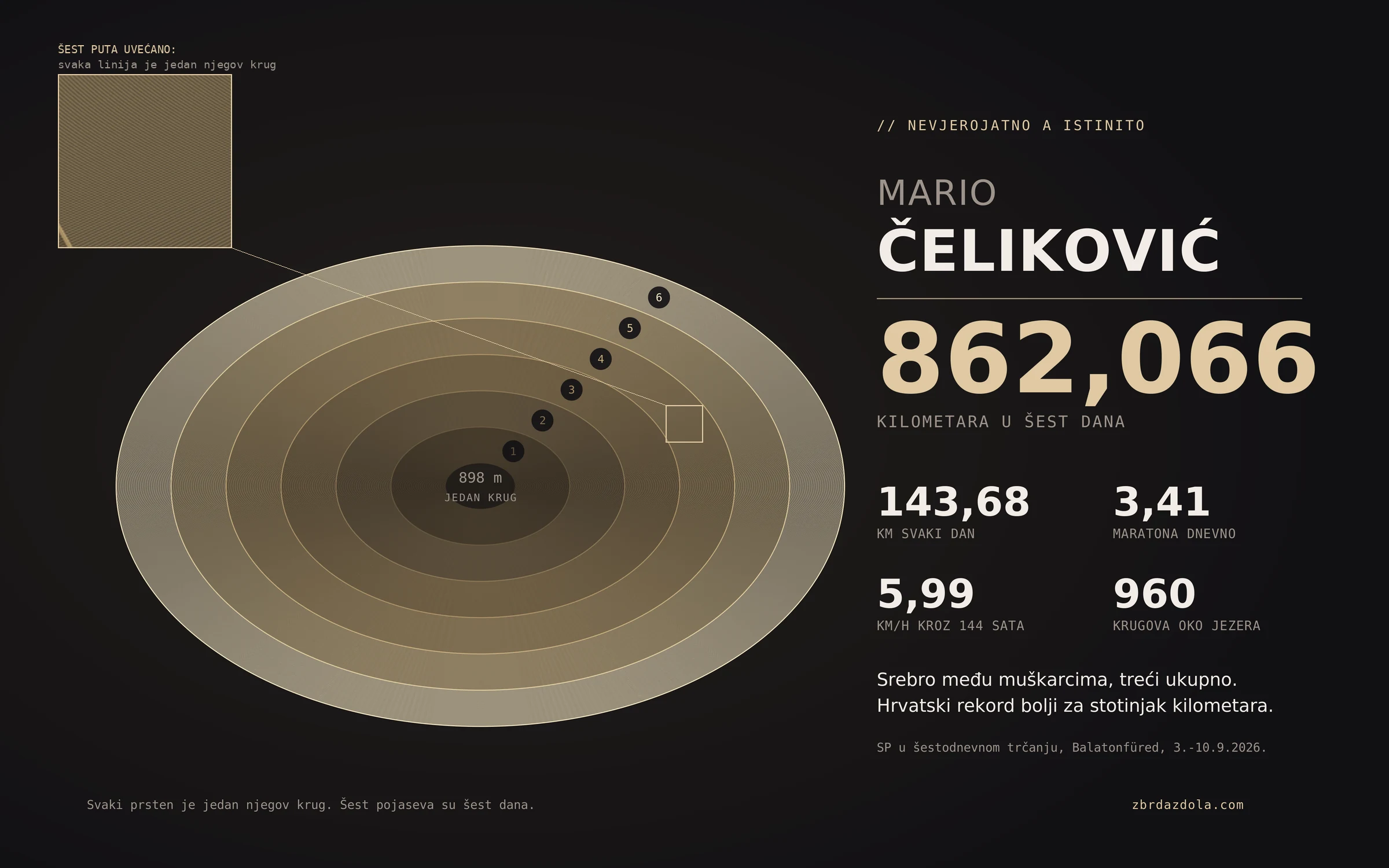
Mario Čeliković from Slavonski Brod ran 862 kilometres in six days. His surname means "of steel" in Croatian, which is too good to be a coincidence, and the number is one you first read as a typo.
There are results you read twice because you assume somebody mistyped them. This is one: 862.066 kilometres in six days.
Mario Čeliković from Slavonski Brod ran that in early September at Balatonfüred, at the six-day running world championship. He took silver among the men and third place overall, and improved the Croatian record by about a hundred kilometres. Not by a few hundred metres. By a hundred kilometres, which in the long jump would be roughly a metre and a half of progress in one go.
And his surname is Čeliković, from čelik, steel. That is too neat to be a coincidence, and I admit it is the reason this piece exists.
Here is what the number means once you break it up. It is 143 kilometres a day, six days running. A little over three marathons every day, with no rest day in between. More than twenty marathons in a week. In our own distances, it is twice the road from Zagreb to Split.
But the worst figure is none of those. The race lasts 144 hours and everything is measured: the running, the standing, the sleeping. His average across the whole 144 hours, sleep included, works out at 5.99 km/h. That is brisk walking pace, held without a break for six days and six nights. Every hour he spent lying down had to be paid back somewhere.
And one more detail, to me the hardest of all. The course was an asphalt loop 898 metres long. He went round that same loop roughly 960 times. The same trees, the same bend, the same water tent, nine hundred and sixty times. When people talk about endurance they usually mean legs. Here the legs are the easy part.
The overall winner was Megan Eckert of the United States with 1,024 kilometres, a women’s world record and ahead of every man in the field. First among the men was Simen Holvik of Norway with 941 kilometres, Čeliković second, and fourth was Szabolcs Beda of Hungary - whom Čeliković held off by not quite nine kilometres. After six days of running, nine kilometres is a gap you can lose in one bad afternoon.
Croatia also took team bronze, with Mirko Antoljak.
What puts this in Life rather than in sport is the question left standing once the numbers settle. On the sixth day, somewhere around the seven hundred and fiftieth kilometre, no amount of training is carrying you any more. The body said everything it had to say long ago. What is left is the decision to do one more lap of the same lake, and then one more.
That is persistence, the perfectly ordinary kind, the same one that finishes any job you start. The only difference is that he held on to it to the end of the sixth day.
links