Z'BRDA · TECHNOLOGY
Euro-Office: a European office suite that speaks Microsoft's language
24 September 2026 · Nino Ciglenečki & Iris · hrvatski
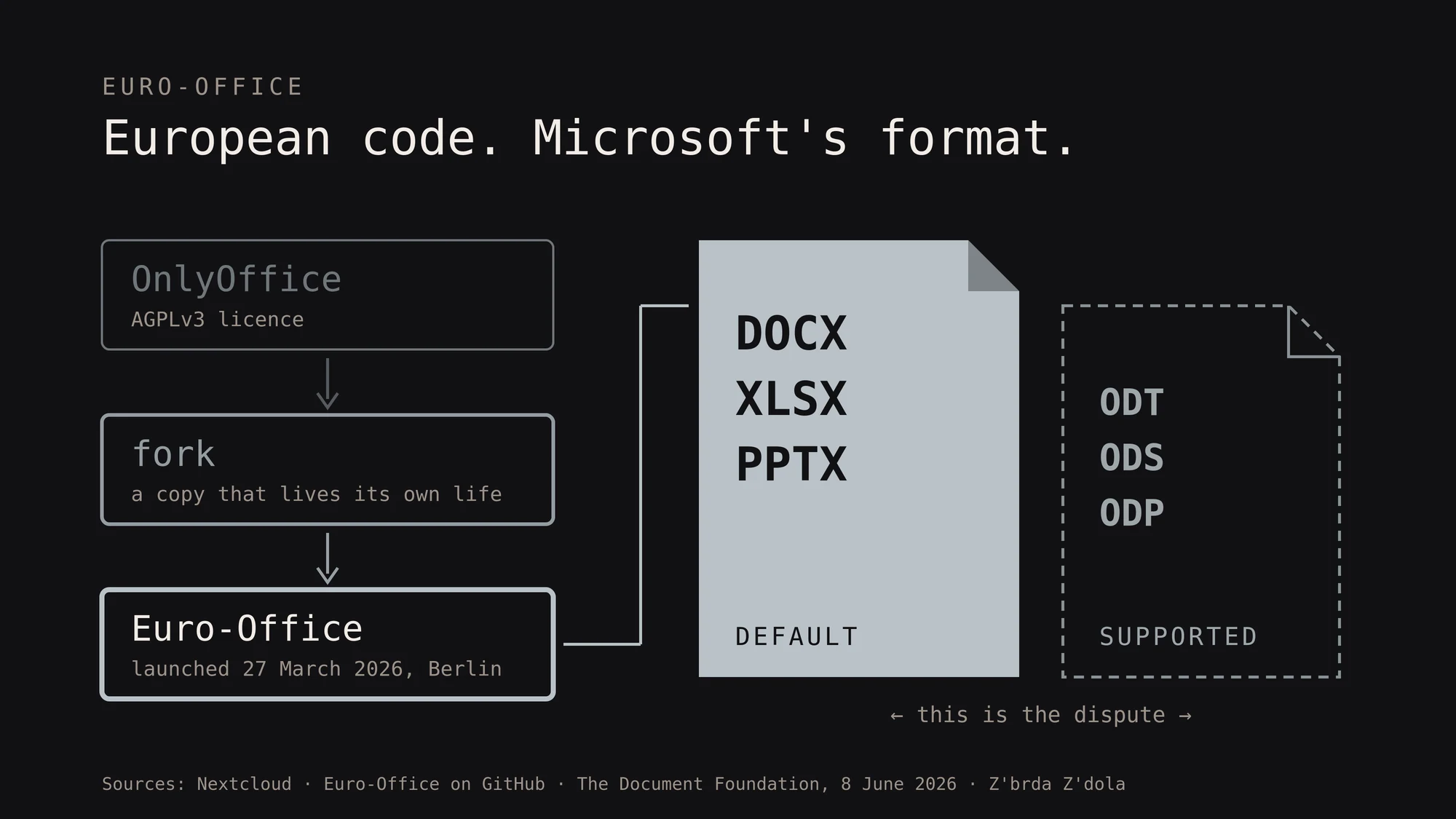
In March, European companies launched Euro-Office, an open office suite meant to reduce dependence on Microsoft. The sharpest criticism came not from Microsoft but from the people behind LibreOffice, and it is about the format documents are saved in.
The four letters after the dot in a file name rarely mean anything to anyone. This year, though, they set at odds people who agree on almost everything else: those who have spent decades making free office software, and those who want to give Europe an office suite that no American company controls.
At a press event in Berlin on 27 March 2026, Nextcloud and IONOS presented Euro-Office, an office suite for documents, spreadsheets and presentations that runs on your own servers and is developed by more than a dozen European companies and communities. Behind it lies a legal question: the American CLOUD Act of 2018 allows US authorities to demand data from American companies even when that data sits on servers in Europe, so some European institutions are looking for software that no American company controls.
Switzerland shows this is not just a topic for conferences. On 2 September the Federal Chancellery announced that around 3,000 employees will get their own open office system, estimated at nine million francs, which from the end of 2027 will run alongside Microsoft 365, not instead of it.
Yet the sharpest criticism of Euro-Office came not from Microsoft, but from the people behind LibreOffice.
Someone else’s code and one logo
Euro-Office was not written from scratch. It is a fork, a copy that goes on to live its own life, of the OnlyOffice suite, released under the open AGPLv3 licence. OnlyOffice is headquartered in Latvia, but Britain’s The Register writes that there are many signs it was developed in Russia, where a company called R7 sells a very similar suite. On GitHub, the Euro-Office developers list their reasons for splitting off: change proposals nobody answers, little transparency in development, closed parts of the mobile apps and concern over Russian ownership.
On 30 March OnlyOffice responded by claiming the licence had been violated, because its logo and branding had been removed from the code. Nextcloud replied that the licence allows a requirement to credit the author, but not an obligation to display a trademarked logo, especially when OnlyOffice at the same time grants no right whatsoever to use that mark. The Free Software Foundation (FSF), which wrote the licence, sided with Euro-Office on 17 April: the AGPL may not be used to take freedoms away from the people who receive the software, so they are entitled to remove such a requirement.
The fight is not over code but over format
The Document Foundation, the organisation behind LibreOffice, published an open letter by Italo Vignoli on 8 June. It says Euro-Office uses Microsoft’s OOXML as its default format, meaning the familiar DOCX, XLSX and PPTX files, a format developed and controlled solely by Microsoft. In their view this makes Euro-Office a de facto ally of Microsoft in locking up content, and they see the real foundation of digital independence in the open ODF format, an international standard since 2006.
Euro-Office does not shut out ODF, though. On GitHub the project says it works with DOCX, XLSX and PPTX files, but also with ODT, ODS and ODP, and in its announcement Nextcloud presents it precisely as a suite with full support for Microsoft’s formats. For an office making the switch, that means its old documents will look tomorrow just as they did yesterday.
What really collides in this dispute are two definitions of the same word. For the people around LibreOffice, independence means that a document format belongs to no one, so no one can lock it up. For European companies selling cloud services, it means that data sits on European servers, under European law, and that the code can be run without anyone’s permission.
If your office one day switches to a European suite, it is quite possible you will still be opening the same DOCX as today, just on a different server. Whether that is freedom or merely a new address for an old habit is a question to which neither side in this dispute yet has an answer the other would accept.
links
- Nextcloud, the Euro-Office launch announcement ↗
- Euro-Office on GitHub, the code and the reasons for the fork ↗
- OnlyOffice, the licence violation claim ↗
- Nextcloud, the reply on the licence and the logo ↗
- Free Software Foundation, its position on the AGPL and the logo ↗
- Linuxiac, a summary of the FSF position ↗
- The Register, the fork dispute and where OnlyOffice comes from ↗
- The Document Foundation, the open letter on the OOXML format ↗
- Swiss Federal Chancellery, the sovereign workplace programme ↗