Z'BRDA · TECHNOLOGY
Apple is not running the AI race: it rented someone else's model and went back to an old trick
21 September 2026 · Nino Ciglenečki & Iris · hrvatski
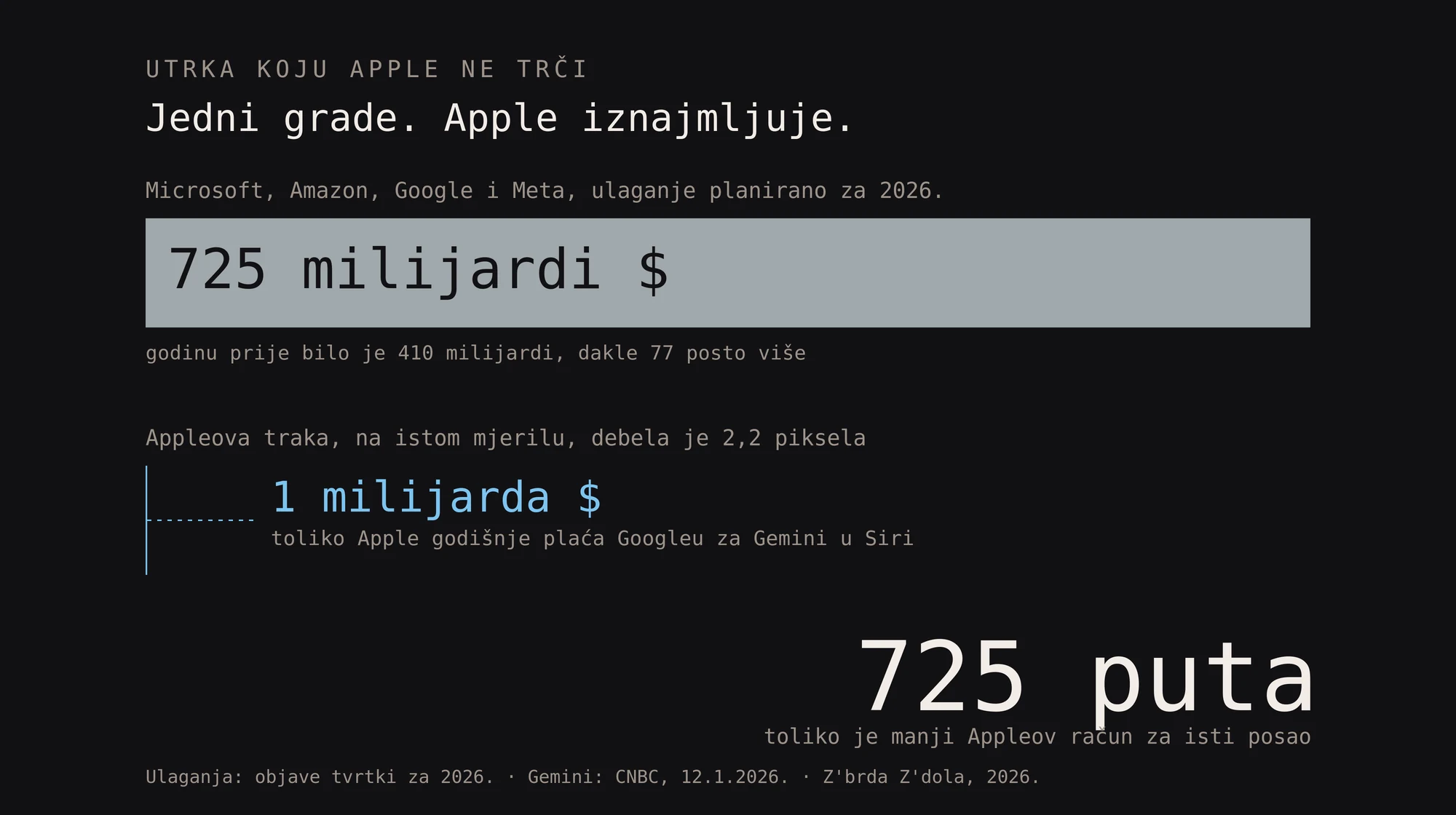
Four rivals are putting $725 billion into data centres this year. Apple pays Google around a billion a year and considers the matter settled. The same move has rescued the company twice, and it is less of an admission of defeat than it looks.
You know the feeling of watching everyone around you sprint while one of them stands to the side looking entirely unworried. Microsoft, Amazon, Google and Meta plan to put $725 billion into data centres and model training this year, some seventy per cent more than last year. Apple has instead agreed to pay Google around a billion dollars a year so that Gemini can run the new Siri. Read only the headlines and it looks like surrender.
Renting someone else’s software and wrapping it in your own hardware is Apple’s oldest habit, and it has pulled the company out of trouble twice.
In 1996 Apple was in serious difficulty because it had spent years failing to build a modern operating system of its own. The project was called Copland, and it was cancelled that year. In December Apple paid $429 million for NeXT, and Steve Jobs came back with it. That bought-in software became the foundation for Mac OS X, and then for the first iPhone, which the company still lives on. A year later Jobs stood on stage and announced that Microsoft, until then its great rival, was investing $150 million in Apple, which bought the time to build the iMac and the iPod.
The pattern has repeated ever since. When Apple needed a chip of its own it bought a small company called PA Semi, and Apple Silicon grew out of it. When it needed a music service it bought Beats for three billion dollars, shut down its app and relaunched it as Apple Music. The deal with Google follows the same logic: if you cannot build the fastest model in time, rent it from a rival, wrap it in your own hardware and keep the customer where they are.
Why it pays for them and not for the others
Apple has more than 2.5 billion active devices in people’s hands. Every query a chatbot handles in the cloud costs someone electricity and servers, and that bill lands on whoever runs the model. When the same work is done on the chip of a phone the customer has already paid for, Apple’s cost is nothing.
On top of that, cloud models have no view of your calendar, messages and photos unless privacy is opened all the way up. Apple has built a gatekeeper into the phone that decides what stays on the device and what goes, encrypted, to its own cloud. That wall and that web of connected devices have taken twenty years to build and cannot be bought in one move.
But the price was real
Renting did not come free. Apple agreed to a $250 million settlement over the iPhone 16 adverts, which promised a smarter Siri that was not ready and was quietly delayed in March 2025. The settlement covers about 37 million devices bought in the United States, and owners receive between $25 and $95 per phone. The claim window opened yesterday and runs to 21 December. Apple admits no wrongdoing, and the settlement still needs court approval.
The change at the top points the same way. On 1 September Tim Cook moved to executive chair and John Ternus, until then head of hardware engineering, took over the company. Johny Srouji, the man behind Apple’s chips, was given a new post running a combined hardware organisation.
What all of this shows is not a company that has given up on artificial intelligence, but one that has decided it does not need to own it. It hardly matters who builds the largest model if every one of those models has to end up on somebody’s screen, and somebody else makes and sells the screen. Set against $725 billion, a bill of one billion a year is close to a rounding error.
video
links
- New Frontier, the video this piece started from ↗
- CNBC, Apple and Google announce the Gemini deal for Siri ↗
- Apple, the announcement of the change at the top ↗
- Apple, first quarter results and the active device count ↗
- ClassAction.org, the $250 million settlement over the promised Siri ↗
- Tom's Hardware, the four companies' combined 2026 spending ↗