Z'BRDA · HEALTH
Green tea is worth two percent: what actually shrinks visceral fat
18 August 2026 · Nino Ciglenečki & Iris · hrvatski
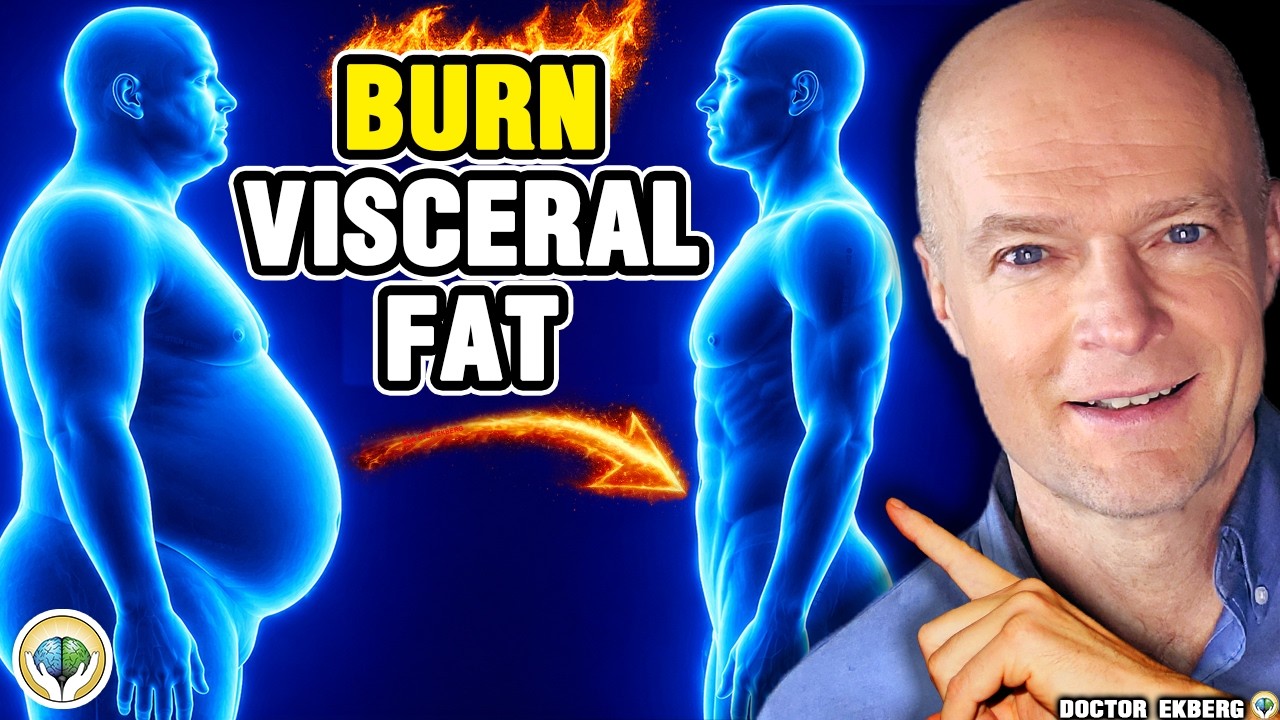
There is no shortage of advice about visceral fat, and all of it sounds equally important. So instead of a list, Sten Ekberg drew a scale - how much of the total effect each single item accounts for. The biggest one turns out not to be something you do, but a consequence of everything else.
Sten Ekberg is one of the best YouTubers teaching me about health and eating well. His videos are brilliant - he explains the mechanism rather than the trick, and he almost always ends by saying where the limits of what he’s explaining lie.
This one is about visceral fat, the kind that doesn’t settle under the skin but between the organs.
There is no shortage of advice against it, and all of it sounds equally important. Green tea, less stress, more vegetables, the gym, less sugar
- ten items get listed and you come away thinking all ten are worth roughly the same. They aren’t remotely. And whoever starts with the one that counts for least will spend their willpower and give up, even though what they were doing was right.
So Ekberg did the thing nobody does: instead of a list, he drew a scale.
What each thing is worth
He took everything that helps against visceral fat at all to add up to a hundred percent of the effect. Then he gave each single item its slice of that pie - how much of the total result comes down to that one thing.
It isn’t a measurement, and he says so; more on that below. But it is a ranking by importance, and a ranking is what you actually need when deciding where to put the effort. Here’s how he filled it in, from the smallest to the largest:
Carotenoids and catechins - 2 to 3%. The pigments in vegetables, and the compound in green tea. There is a mechanism, there are studies. But two or three hundredths.
Alcohol - 5%. The liver has priorities. When alcohol arrives, fat burning is paused until it’s gone, because alcohol carries almost as much energy per gram as fat. That figure is for one or two drinks a day; for a heavy drinker who quits, the item weighs far more.
Stress and cortisol - 10%. This was the part I found most interesting. Visceral tissue has more cortisol receptors than subcutaneous tissue, so cortisol ends up precisely there. And cortisol’s job is to raise blood sugar - either from stores, or by making you eat something fast. Hence the craving for bread and sweets under pressure.
Exercise - 15 to 20%. More on that below.
Food quality and insulin - 25%. Insulin is the only thing that tells the body to store. When it’s permanently high, fat can’t even be released. So you’re hungry despite having reserves - because you can’t get at them.
The rest - a calorie deficit. By his own split, subtraction leaves around 40 percent. The single biggest item on the scale.
A food deficit has to exist
This is where the usual conclusion is expected - so count calories. Ekberg says the opposite.
A food deficit must exist, otherwise the body has no reason to spend what it stored. But counting calories without changing the quality of the food means being slightly hungry all the time, and nobody sustains that for life.
That’s why the five items above are in that particular order. They are not an alternative to the deficit. They are how the deficit comes about on its own - and, more to the point, how it lasts. A diet you hold for a month has solved nothing.
Where the numbers came from - and why that raised my trust rather than lowering it
Halfway through, Ekberg says something you rarely hear: he arrived at the percentages working with AI tools, they are not absolutes, and they can vary widely from person to person.
He could have kept quiet. A number on a chart looks like a measurement and nobody would have asked. He said it, and in doing so made clear that the chart isn’t a measurement but a ranking by importance - and the ranking is the part that’s actually useful.
For us on this site that’s a somewhat close-to-home subject, so it was good to see what it looks like when someone handles it honestly.
Exercise
His recommendation, briefly: a lot of long, easy aerobic work at 60 to 70 percent of maximum heart rate - enough that you can still speak. At that rate it’s almost purely fat being burned, there’s little wear and tear, and you can do it daily.
Alongside that, very short intervals at maximum intensity, two or three times a week, twenty to thirty seconds each. His favourite form: sprinting uphill - because uphill you reach the same heart rate at half the speed, which makes it safer.
And resistance training, not for the fat but for the muscle.
What he left out as necessary: long moderate cardio sessions in a gym. If you enjoy them, fine, he says - but you don’t need them.
So: a long climb at an easy pace, then a few short bursts uphill. That is a description of a day in the mountains. I’ve been doing exactly that for years, and not for the fat - because I like it.
Who Sten Ekberg is
Sten Ekberg is Swedish, born in 1964, and before the health chapter of his career he was an Olympian - decathlon, Barcelona 1992, ninth place with 8,136 points and a Swedish record of 8,246. He earned his Doctor of Chiropractic in 2007 at Life University in Georgia, where he still practises.
So: a world-class athlete and a chiropractor, not a physician. I’m neither - just someone this interests, for the sake of my own health and the will to keep good habits going.
The reason I wrote this down at all:
No single item is the solution. The solution is the ranking - knowing what’s worth two percent and what’s worth forty, so you don’t spend your willpower in the wrong place.
The video is below. The channel is Dr. Sten Ekberg, and it’s worth following in full.
